

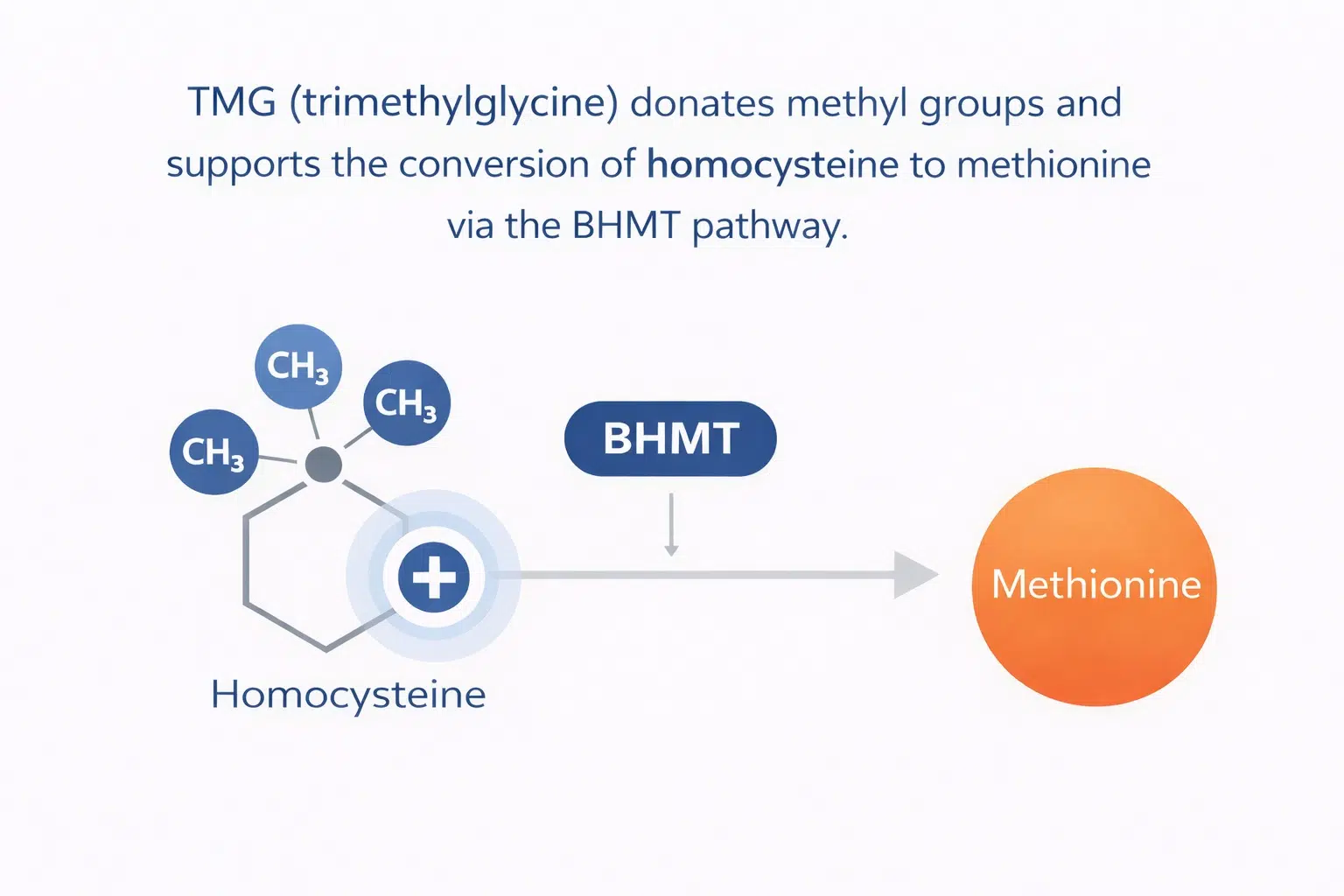
TMG supports methylation by providing methyl groups and helps convert homocysteine to methionine via the BHMT pathway.
It starts with methylation: a fundamental process
Methylation is an essential biochemical process involved in energy production, detoxification, DNA regulation, and the conversion of nutrients. It is literally “teamwork” in your metabolism: methyl groups are repeatedly passed on to allow all kinds of reactions to run.
TMG (trimethylglycine), also known as betaine, is a natural substance that acts as a methyl group donor. Chemically, it is the same substance as “betaine” (see, for example, PubChem: Betaine (CID 247)).
The body uses TMG to transfer methyl groups, including in the conversion of homocysteine back to methionine (an important step within the so-called one-carbon/methylation metabolism).
But how exactly does TMG work? Why do people take TMG? And what can you realistically expect from it within a healthy lifestyle—without medical claims?
How does TMG work in your body?
Methylation is teamwork. Your body uses methyl groups for hundreds of biochemical reactions—from “turning on” or “slowing down” processes to recycling building blocks.
TMG actively supplies methyl groups and thus supports the methylation balance. The best-known route here is the BHMT route (betaine-homocysteine methyltransferase), where betaine/TMG donates a methyl group to convert homocysteine to methionine.
Would you like to see the exact enzyme and its function? See, among others, GeneCards: BHMT (betaine–homocysteine S-methyltransferase).
Why TMG and not just B vitamins?
Folate (B9) and vitamin B12 are important for methylation, but TMG works via a parallel pathway (BHMT route). That is precisely why TMG is often combined with B vitamins: multiple routes can support the same goal, depending on nutrition, stress, training, and individual needs.
What can you realistically expect?
TMG is not a medical treatment and not a quick fix. Consider it a targeted supplement for methylation processes, alongside nutrition, sleep, exercise, and stress management. Research shows that betaine/TMG supplementation in studies can lower plasma homocysteine, primarily depending on dosage and baseline values (e.g., meta-analyses and RCTs as discussed in the meta-analysis on betaine and homocysteine).
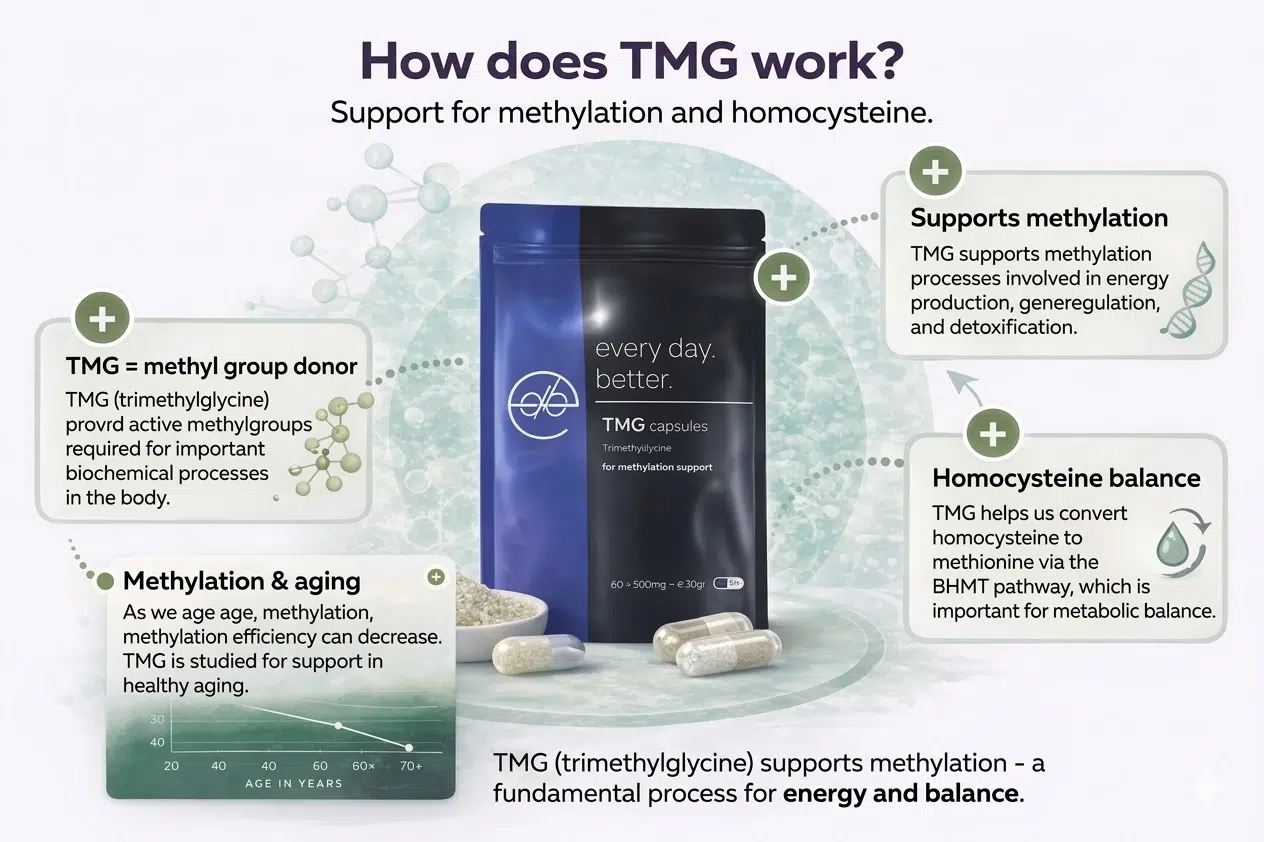
What is TMG? How does TMG work and what can it offer you?
TMG: the methyl group donor
TMG stands for trimethylglycine (also known as betaine). It is a natural substance with three methyl groups that your body can utilize as a methyl group donor.
The “goal” of TMG in supplement form is usually: supporting methylation processes and supporting the conversion of homocysteine.
TMG works as a practical “methyl donor” alongside other methylation nutrients such as folate (B9) and vitamin B12.
TMG & homocysteine (BHMT pathway)
One of the best-known mechanisms of action of TMG is via the BHMT pathway (betaine-homocysteine methyltransferase). In this pathway, TMG can donate a methyl group, allowing homocysteine to be converted into methionine.
Methionine is then once again a building block in the methylation network, including processes related to SAMe (a key methyl group donor in the body).
In short: TMG supports methylation partly via a “parallel pathway” (BHMT), which makes it interesting as a supplement to B-vitamin-driven methylation.
TMG in food
TMG occurs naturally in, among other things, beets, spinach, quinoa, and whole grains. In supplement form, people sometimes opt for TMG because it is consistent and easy to dose in a targeted manner—especially if you are consciously working on methylation or homocysteine support.
Practically speaking: preferably choose pure raw materials, transparent dosage, and a product without unnecessary additives.
TMG & methylation balance
Methylation is a fundamental biochemical process involved in all kinds of “regulation processes” in the body: from gene expression to metabolic pathways. TMG is therefore often mentioned in the context of methylation balance: supplying methyl groups can help to “keep the system running” when the need is higher (for example, due to lifestyle, nutrition, stress, or individual variation).
Important: this is support, not a “quick fix” and not a medical treatment.
The 3 core steps behind how TMG works
- Supplying methyl groups
TMG functions as a direct methyl group donor within one-carbon/methylation metabolism. - Supporting homocysteine conversion
Via the BHMT pathway, TMG can help convert homocysteine to methionine (mechanism: BHMT explanation). - Downstream effects
A stable methylation process can contribute to processes that people associate with energy, focus, and vitality—as part of lifestyle and nutrition (not as a medical claim).

What is the best time to take TMG?
TMG is usually taken in the morning or with a meal. Consistency is more important than timing. Many people opt for “with breakfast” because that is the easiest to maintain.
What is a common dosage?
In supplement routines, you often see 500–1,500 mg per day (depending on the product and goal). In a clinical context (medical supervision), higher dosages may occur, but that falls outside of “normal supplement use.” For medicinal betaine (in cases of homocystinuria), official sources refer to dosage under medical supervision (see MedlinePlus: Betaine and DailyMed: Betaine anhydrous).
What are the potential benefits of TMG?
- Support of methylation processes
- Support of homocysteine balance (depending on baseline value and context)
- Support of energy and metabolic processes (indirectly, as part of methylation)
- Support of cognitive processes (indirectly, via methylation and neurotransmitter pathways)
For whom is extra caution wise?
If you are using medication, are pregnant/breastfeeding, or have a medical condition (such as a metabolic disorder related to homocysteine/methionine), please consult a physician. This is particularly relevant because betaine affects methylation metabolism and is actively used in medical settings (see MedlinePlus / DailyMed).
What do these terms mean?
- TMG – Trimethylglycine (betaine)
- Methylation – transfer of methyl groups
- BHMT – enzyme pathway for homocysteine conversion (betaine-homocysteine methyltransferase)
- Homocysteine – amino acid involved in methylation
- Methionine – essential amino acid (building block for, among other things, SAMe)
- SAMe – important methyl group donor in the body
External sources and references for TMG
TMG stands for trimethylglycine and is also frequently called betaine. In scientific literature, TMG is primarily discussed as a substance involved in methylation, homocysteine metabolism, and the osmotic balance of cells.
For those who wish to delve deeper into TMG, you can start with the external sources below:
- Beneficial Effects of Betaine: A Comprehensive Review
A broad scientific review article on TMG/betaine, focusing on its role as a methyl donor and potential effects on methionine homeostasis and liver health.
View the study on MDPI - Betaine in Inflammation: Mechanistic Aspects and Applications
This publication describes betaine as a substance that functions physiologically as an osmoprotectant and methyl group donor, and explores the potential mechanisms of action in depth.
View the publication on Frontiers - Choline – Health Professional Fact Sheet (NIH Office of Dietary Supplements)
This NIH source is valuable as a background resource, as it explains the relationship between choline, betaine, and methylation.
View the NIH factsheet
References
Read also:
Methylation is one part of a larger longevity picture. In this overview guide, you can read how TMG, GlyNAC, and NMN are viewed together within strategies for healthy aging.

