
GlyNAC research: what does the science say about its effects and safety?
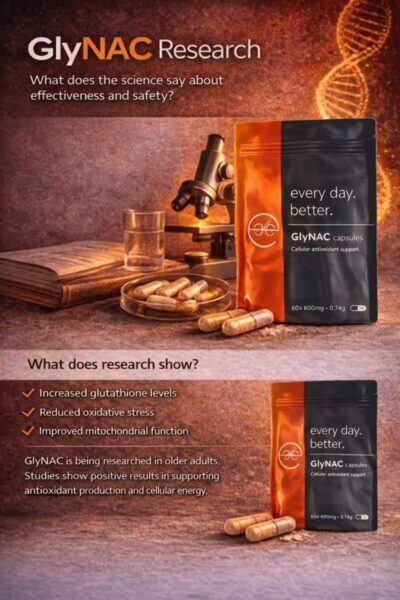
Interest in GlyNAC has increased sharply in recent years, especially within scientific research into aging, glutathione, and cellular energy. GlyNAC is being investigated as a way to support the body in processes that come under pressure with aging, such as antioxidative protection and mitochondrial function.
In this article you will read:
- why GlyNAC is interesting for scientific research
- what studies say about glutathione and aging
- which effects have been investigated
- how GlyNAC fits within evidence-based supplement use
For a general explanation of its operation and background, you can also start at
👉 GlyNAC explained: effects, safety and research
Why is GlyNAC interesting for research?
As we age, several changes occur at the cellular level, including:
- decrease in glutathione levels
- increased oxidative stress
- reduced mitochondrial efficiency
- slower recovery processes
Researchers are interested in GlyNAC because it:
- provides essential building blocks (glycine + cysteine)
- supports the body within its own regulation
- does not add direct antioxidants, but supports endogenous production
This makes GlyNAC interesting within research into cellular energy, recovery and balance.
Glutathione and aging
Glutathione is a natural antioxidant that plays a central role in:
- protection against free radicals
- detoxification
- maintenance of mitochondrial function
- recovery at the cellular level
Several studies show that glutathione levels decrease in aging adults. This decrease is associated with:
- increased oxidative damage
- reduced energy production
- reduced metabolic flexibility
Because glutathione consists of multiple amino acids, a deficiency in one building block can limit total production.
What exactly does GlyNAC research investigate?
Scientific research into GlyNAC focuses primarily on:
1. Glutathione production
Researchers are looking at whether supplementation with GlyNAC leads to:
- increased glutathione levels
- improved antioxidative capacity
This mainly looks at older populations, as deficiencies are more common there.
2. Oxidative stress
Oxidative stress occurs when free radicals are formed faster than the body can neutralize them. GlyNAC is being investigated for its role in:
-
reducing oxidative markers
-
supporting antioxidative balance
This aligns with broader longevity themes, such as supplements for healthy aging.
3. Mitochondrial function and energy
Mitochondria are the power plants of cells. Glutathione plays an important role in protecting these structures.
Research into GlyNAC looks at, among other things:
- mitochondrial efficiency
- energy production
- cellular resilience
These processes are further explained at
👉 Cellular energy, recovery and balance
4. Metabolic health in the elderly
Some studies focus on the relationship between GlyNAC and:
- insulin sensitivity
- muscle function
- inflammatory markers
Although these areas of research are still under development, they are seen as promising within aging research.
What does research say about GlyNAC vs loose NAC?
Loose NAC has been investigated for some time as a precursor to glutathione. However, recent research suggests that:
- supplementing cysteine alone is sometimes insufficient
- glycine may be a limiting factor
- combination supplementation (GlyNAC) may give a more complete effect
This difference is explained in detail at
👉 GlyNAC vs NAC
Is GlyNAC scientifically proven?
Important to remain nuanced:
- GlyNAC is not a medicine
- many studies are relatively small-scale
- research focuses primarily on mechanisms, not on disease treatment
What is clear:
- the biochemical substantiation is strong
- the amino acids used are well known
- safety with normal use is confirmed in studies
This means that GlyNAC fits within an evidence-informed approach to supplement use.
Where can you find scientific research on GlyNAC?
Scientific publications on GlyNAC, glutathione and aging can be found via PubMed, a database of biomedical literature:
👉 https://pubmed.ncbi.nlm.nih.gov/?term=GlyNAC+glutathione+aging
Here you will find:
- human studies
- mechanistic explanations
- peer-reviewed articles
How does GlyNAC fit within responsible supplement use?
Within a responsible supplement policy, the following applies:
- lifestyle forms the basis
- nutrition remains essential
- supplements support, but replace nothing
GlyNAC is therefore often combined with:
- healthy food
- exercise
- stress management
More practical information about use can be found at
👉 GlyNAC dosage
Safety and research
Research to date shows that GlyNAC:
- is well tolerated in healthy adults
- does not cause serious side effects at common dosages
You can read more about this at
👉 GlyNAC side effects
Conclusion
Scientific research into GlyNAC shows that:
- the biological basis is strong
- glutathione and aging are closely related
- combination supplementation with glycine and NAC is logical from a biochemical perspective
Although further research is needed, GlyNAC is being taken more and more seriously within the domain of healthy aging and cellular vitality.
Continue reading
- 👉 GlyNAC explained
- 👉 GlyNAC dosage
- 👉 GlyNAC side effects
- 👉 GlyNAC vs NAC
- 👉 Supplements for healthy aging
Frequently asked questions about GlyNAC research
Want to know what research says about GlyNAC, glutathione, oxidative stress, and healthy aging? Below you will find practical answers about the scientific background of GlyNAC. This information is intended as a general explanation and does not replace medical advice.
What is being researched regarding GlyNAC?
Research into GlyNAC primarily focuses on the combination of glycine and N-acetylcysteine, also known as NAC. These two substances are building blocks that the body uses to produce glutathione.
Glutathione is an important endogenous antioxidant. Therefore, researchers are looking at the relationship between GlyNAC, oxidative stress, mitochondrial function, energy metabolism, muscle function, and healthy aging, among other things.
Why is glutathione important in GlyNAC research?
Glutathione helps protect cells against oxidative stress and plays a role in normal cellular processes. The body produces glutathione itself from amino acids, including cysteine, glycine, and glutamate.
GlyNAC provides two of these building blocks: glycine and cysteine via NAC. Therefore, GlyNAC is being researched as a way to support the body’s own glutathione production.
What is the link between GlyNAC and oxidative stress?
Oxidative stress occurs when there are more free radicals present than the body can effectively neutralize. This can strain cellular processes and is often discussed in relation to aging, recovery, and general health.
Because glutathione is a key antioxidant, GlyNAC is being studied for its potential role in supporting antioxidant capacity and cellular balance.
What does research say about GlyNAC and aging?
GlyNAC is primarily researched in the context of healthy aging, as levels of certain amino acids, glutathione status, and mitochondrial function can change with age.
Some studies suggest that supplementation with glycine and NAC may have interesting effects on markers associated with oxidative stress, mitochondrial function, and physical performance. This does not mean that GlyNAC prevents or cures aging, but it does make GlyNAC interesting within longevity research.
Is GlyNAC scientifically proven?
GlyNAC is scientifically interesting, and there are studies showing positive signals, particularly regarding glutathione, oxidative stress, and metabolic health. At the same time, research is still developing.
It is therefore important to view GlyNAC realistically: as a supplement that can support biological processes, not as a medicine or a guaranteed solution for health problems.
Why does GlyNAC combine glycine with NAC?
NAC provides cysteine, one of the building blocks of glutathione. Glycine is another important building block. By combining both, GlyNAC supports the glutathione pathway more completely than NAC alone.
This is exactly why GlyNAC is often more interesting in research than standalone NAC: it addresses multiple limiting building blocks simultaneously.
Is GlyNAC being researched for energy and mitochondria?
Yes, GlyNAC is also being researched in relation to mitochondrial function. Mitochondria are the powerhouses of the cell and play a vital role in energy production, recovery, and overall vitality.
Because oxidative stress and glutathione status can influence cellular processes, GlyNAC is relevant in research on energy, recovery, and healthy aging.
Can you use GlyNAC daily based on research?
Many people use GlyNAC daily as part of a routine for recovery, vitality, and healthy aging. Research provides interesting insights, but the correct dosage and duration of use can vary per person.
Always follow the recommended dosage on the label. If you are taking medication, are pregnant, breastfeeding, or have a medical condition, consult a doctor or pharmacist first.
Is GlyNAC research the same as proof of medical efficacy?
No. Scientific research into GlyNAC does not automatically mean that GlyNAC has a medical effect or can treat diseases. Much research looks at biological markers, processes, and potential support.
For supplements, it is important not to make medical claims. GlyNAC can fit within a healthy lifestyle, but it is not a substitute for medical treatment.
What should I look for when reading GlyNAC studies?
When reading GlyNAC studies, pay attention to the research group, dosage, duration of the study, measured outcomes, and whether the research was conducted on humans or animals.
A small study or research into biomarkers is interesting, but does not automatically mean the same effects apply to everyone. Therefore, always look at the overall picture of the research.

