
What is NMN and why is it important for energy, aging and health?
Definition: what is NMN?
Short answer: NMN (nicotinamide mononucleotide) is a molecule your body makes and uses to produce NAD+, a coenzyme needed for energy production and DNA repair. In human studies, 250 to 900 mg of NMN per day raised NAD+ in the blood (Yi et al., 2023; Okabe et al., 2022) and was well tolerated over weeks to months (Fukamizu et al., 2022). Effects on how people feel or function are smaller and mixed, and there is no evidence that NMN slows human aging.
In this guide, we explain step-by-step what NMN is, how it works, what the science says, how safe it is, and what to look for when choosing a high-quality NMN supplement.
Table of contents
- Definition: what is NMN?
- What exactly is NMN?
- How does NMN work in the body?
- Multiple mechanisms of action
- What does NMN do to your body?
- What does science say?
- Is NMN safe?
- NMN experiences
- NMN and specific applications
- NMN vs other NAD+ precursors
- NMN vs NR vs niacin: what do you choose when?
- How do you choose a good NMN supplement?
- Frequently asked questions (FAQ)
- Transparency & disclaimer
- Scientific sources
What exactly is NMN?
NMN stands for nicotinamide mononucleotide. It is a natural precursor to NAD+ (nicotinamide adenine dinucleotide), a coenzyme found in every cell of the human body.
NAD+ plays a central role in:
- energy production in the mitochondria
- repair of DNA damage
- regulation of metabolism
- protection against cellular aging
From about the age of thirty, the NAD+ level gradually decreases. This is associated with fatigue, decreasing recovery capacity and changes in cognitive and metabolic functions.
How does NMN work in the body?
NMN increases the availability of NAD+, allowing cells to produce energy more efficiently and recovery processes to proceed better.
Would you like to understand exactly how this process works at a cellular level?
👉 Read the in-depth explanation: How does NMN work in the body?
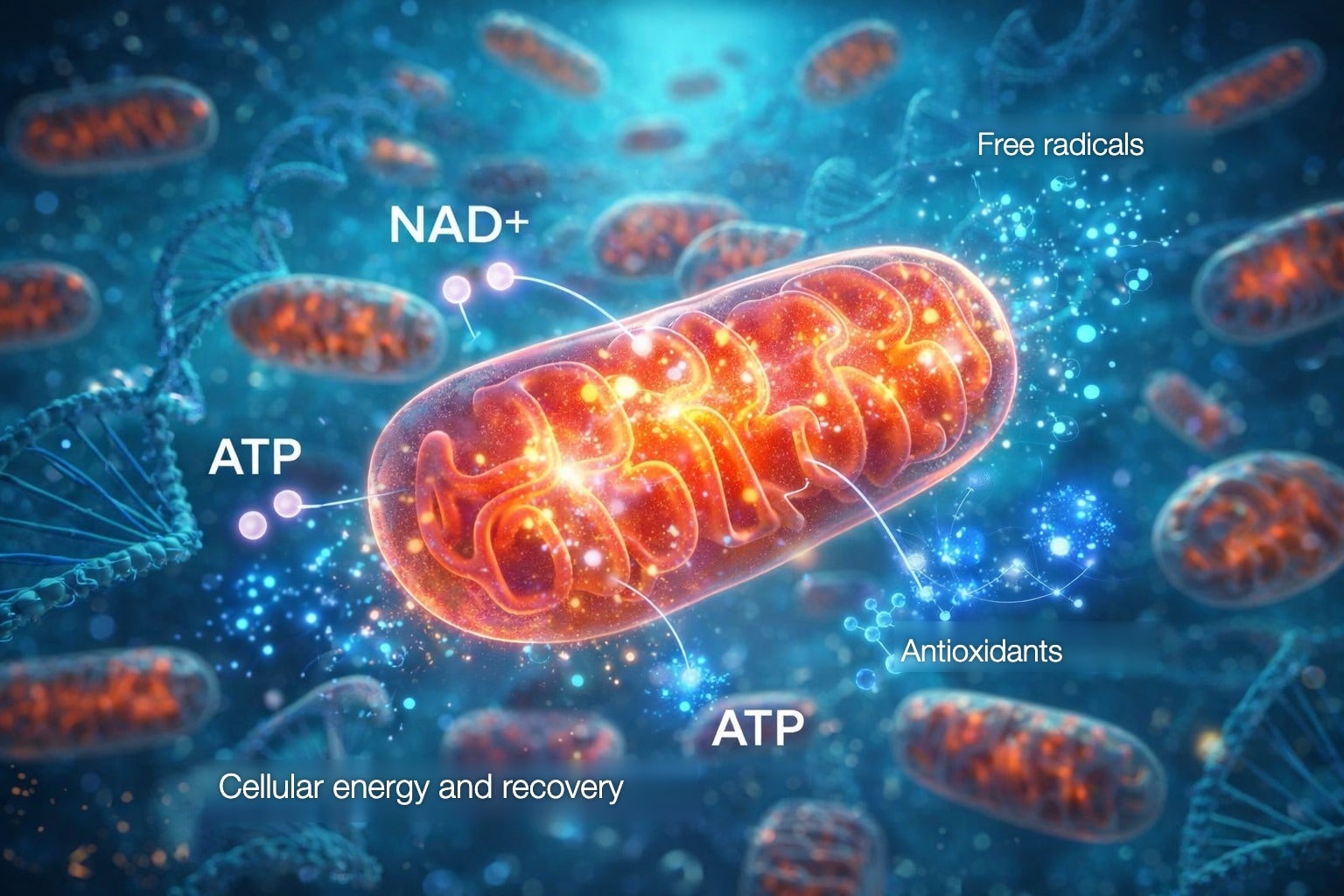

In short
- NMN is ingested
- It is absorbed through the digestive tract
- In cells, NMN is converted into NAD+
- NAD+ activates enzymes such as sirtuins that are involved in energy and recovery
What is NMN and why does it have multiple mechanisms of action?
The question “what is NMN” cannot be answered with a single mechanism. NMN affects multiple processes simultaneously, because NAD+ is involved in hundreds of enzymatic reactions in the body.
In addition to the basic operation via energy production, NMN is being investigated for effects such as:
- support of mitochondrial efficiency
- influence on insulin sensitivity
- role in cell renewal
- interaction with sirtuins
- contribution to recovery processes after exercise
Because this subject is complex, we have broken down the effects of NMN into several concrete aspects.
👉 Read the comprehensive overview here: 12 things about NMN’s mechanism of action
This in-depth look shows how broad the role of NMN truly is, and why the supplement is frequently mentioned in longevity research.
What does NMN do to your body?
Scientific research (mainly preclinical and partly human) shows that increased NAD+ values are associated with:
- a more efficient energy management
- support of muscle function and recovery
- improved insulin sensitivity
- support of cognitive functions
- protection against oxidative stress
NMN is therefore often mentioned in research concerning healthy aging and cellular vitality.
Do you want to know step-by-step what human studies do and do not show? Then read: what does NMN do in your body?
Do you want an overview of all known and researched effects of NMN in a row, including nuance and caveats?
Then this in-depth article is relevant: 👉 how NMN works
What does science say about NMN?
Human studies consistently show that NMN supplementation raises NAD+ levels in the blood, with higher doses giving larger increases (Yi et al., 2023). Effects on health outcomes are more limited: 250 mg per day improved muscle insulin sensitivity in women with prediabetes (Yoshino et al., 2021) and some measures of walking speed and grip strength in older men (Igarashi et al., 2022), while other studies found no clear effect. A 2026 systematic review of 33 human studies concluded that NMN and NR reliably raise NAD+ markers and are well tolerated, but that effects on functional and health outcomes are mixed and often absent (Gallagher et al., 2026). Large, long-term studies are still lacking.
For current developments and research trends, you can also read: 👉 Latest NMN studies 2026: what clinical trials really show
Is NMN safe?
NMN is well tolerated in human studies when used within common dosages. Serious side effects are rare.
Possible, usually mild side effects:
- mild stomach complaints
- headache (occasionally)
Use of NMN is discouraged in:
- pregnancy
- breastfeeding
- medical conditions without consulting a doctor
NMN experiences
Users share various experiences, such as:
- more mental clarity
- more stable energy
- faster recovery after exercise
Experiences are personal and not a guarantee of results.
👉 Read real-life stories and context: NMN experiences
NMN and specific applications
NMN is often discussed in relation to specific themes such as:
- hair health
- sports and recovery
- aging processes
👉 More about one of these applications: NMN and hair growth
All NAD+ boosters side by side? Read Comparing NAD+ supplements: NMN, NR, niacin, NADH, and NAD+.
NMN vs other NAD+ precursors
| Supplement | Characteristic |
|---|---|
| NMN | Direct precursor of NAD+ |
| NR | Alternative NAD+ precursor |
| Niacin | Less efficient route |
NMN vs NR vs niacin: what do you choose when?
Many people searching for what NMN is quickly encounter comparisons with NR and niacin (vitamin B3). These are all substances that can be involved in the body’s production of NAD+, but they differ in pathway, tolerance, and user experience.
- NMN is often chosen by people specifically looking for an NAD+ precursor that is directly mentioned in longevity research.
- NR is an alternative that is also extensively researched within the fields of NAD+ and metabolism.
- Niacin is vitamin B3 and can support NAD+, but higher doses can cause a flush (warmth/redness) in some people.
Which option is most suitable depends on your goal (energy, recovery, longevity focus), sensitivity, and product quality. Please view this primarily as an orientation and consult a professional for medical questions.
How do you choose a good NMN supplement?
When choosing an NMN supplement, it is important to pay attention to:
- high purity
- independent quality controls
- transparency about origin
- no medical claims
At Every Day Better, you can buy NMN capsules and NMN powder that meet all these criteria. Looking for premium quality? Choose Uthever® NMN — the most researched form of NMN.

What is NMN? NMN capsules from Every Day Better to support NAD+ and recovery
Frequently asked questions about NMN (FAQ)
The answers below are intended as a general explanation of what NMN is, how it works, and what to look for. It does not constitute medical advice.
1) What is NMN?
What is NMN? NMN (nicotinamide mononucleotide) is a substance produced naturally by the body, which the body uses to produce NAD+. NAD+ is important for energy production, DNA repair, and cellular processes associated with healthy aging.
NMN occurs naturally in small amounts in the body and in some foods. Because NAD+ levels often decrease with age, NMN is being investigated as a food supplement that can support NAD+ production.
2) What exactly is NMN and what does NMN stand for?
What exactly is NMN? NMN stands for nicotinamide mononucleotide. It is a precursor to NAD+; a building block the body can use to produce NAD+. NMN is part of NAD+ metabolism: a biochemical pathway active in almost all cells.
3) What does NMN do to your body?
NMN supports the production of NAD+, and NAD+ is involved in energy production and recovery processes in cells. In research, NMN is therefore often discussed in relation to energy levels, metabolism, recovery after exertion, and processes related to aging.
Important: effects differ per person. NMN is not a medicine and is not intended to treat diseases.
4) How does NMN work in the body?
NMN is used in the body to increase NAD+, allowing cells to function more efficiently. In short: NMN → NAD+ → support for cellular energy and recovery.
Would you like a technical explanation? Then check out: How does NMN work in the body?
5) What is NAD+ and what does that have to do with NMN?
NAD+ is a co-enzyme that occurs in every cell and is essential for energy production and cellular repair. NMN is a building block that the body can use to create NAD+.
You can think of NMN as “input” and NAD+ as a regulator that controls enzymes and processes supporting energy and recovery.
6) Why does NAD+ decrease with age?
NAD+ can decrease due to natural aging processes and a higher ‘demand’ for repair mechanisms in cells. As we age, metabolic pathways change and the efficiency of some biosynthetic processes decreases.
This subject is complex and the exact causes vary per individual, but the trend of declining NAD+ availability is frequently mentioned in longevity research.
7) Is NMN safe?
NMN is generally well tolerated in human studies when used within common dosages. Serious side effects are rarely reported, but this does not mean it is suitable for everyone.
Consulting a physician is advisable in cases of pregnancy or breastfeeding, medication use, chronic conditions, or doubts regarding interactions and dosage.
8) What are possible side effects of NMN?
Potential side effects of NMN are usually mild, such as slight stomach discomfort or headaches (occasional). Many people experience no side effects.
Tips: start lower, take with water (possibly with a light meal if you are sensitive), and evaluate after 1–2 weeks. Stop if symptoms persist and consult a professional.
9) What is a good dosage of NMN?
There is no universal ‘best’ dosage of NMN; the optimal amount can vary per person. Factors include age, lifestyle, goals, and tolerance.
Practical advice: start lower and build up. Follow the label of the product you are using and consult a professional if in doubt.
10) When is the best time to take NMN?
Many people take NMN in the morning, because NAD+ is linked to energy metabolism and circadian rhythm. Consistency is usually more important than perfect timing.
11) How long does it take for NMN to work?
How quickly you notice an effect varies per person; some people notice a difference within days to weeks, others do not. This depends on sleep, stress, nutrition, training load, baseline levels, and consistency.
12) What is the difference between NMN and NR?
NMN and NR are both NAD+ precursors, but they do not follow the exact same pathway in the body. Which one is more suitable depends on individual response, tolerance, product quality, and goals.
13) What is the difference between NMN and niacin (vitamin B3)?
Niacine is vitamin B3 and can contribute to NAD+ via a different route, but higher dosages can cause a flush. NMN is often chosen because it is generally used without a flush.
14) Is NMN effective?
Research shows that NMN can increase NAD+ levels; the extent to which this leads to noticeable effects varies per person. Human long-term studies are still in development.
15) What is NMN hair growth, and does it really work?
NMN and hair growth are discussed because NAD+ is involved in cellular energy and repair, but direct evidence for hair growth in humans is limited. Hair health is also related to hormones, nutrition, stress, and genetics.
16) What are NMN experiences?
NMN experiences are personal stories from users, but not scientific evidence. Use experiences as context, not as a guarantee.
17) Can you combine NMN with ORS?
Yes, NMN and ORS are sometimes combined because ORS supports hydration and electrolytes, while NMN focuses on cellular energy (via NAD+). Use ORS mindfully if you are on a salt-restricted diet or have medical indications.
18) What is the difference between hydration and ORS?
ORS is a specific combination of electrolytes and glucose that supports water absorption through the intestine. Hydration powders vary greatly in composition and are not always ORS.
19) Who should avoid using NMN?
NMN is often not recommended during pregnancy and breastfeeding and deserves extra caution when using medication or medical conditions. Consult a doctor if in doubt.
20) How do you recognize a high-quality NMN supplement?
You can recognize a good NMN supplement by transparency, purity, and independent quality control. Pay attention to clear dosage, reliable origin information, and avoiding exaggerated medical claims.
21) Is NMN legal in the Netherlands?
NMN is sold in the Netherlands as a food supplement, but regulations may differ per country and period. Always check the current product information and claims.
22) What is NMN summarized in one sentence?
NMN is a substance produced by the body that the body uses to make NAD+, and NAD+ is essential for energy production and cellular repair processes.
Transparency & disclaimer
This page is intended as an informative guide based on available scientific literature. NMN is a food supplement and not a medicine. Always consult a medical professional if in doubt.
Scientific sources
The information on this page is based on public scientific literature and research institutes, including:
- National Institute on Aging (NIA/NIH)
- Lautrup et al. (2024). Roles of NAD+ in Health and Aging. Cold Spring Harb Perspect Med (review, PubMed)
- Liu et al. (2023). Association of NAD+ levels with metabolic disease in a community-based study (PubMed)
- Chu et al. (2022). Regulation of NAD+ metabolism in aging and disease. Metabolism (review, PubMed)
- Yoshino et al. (2021). Nicotinamide mononucleotide increases muscle insulin sensitivity in prediabetic women. Science (PubMed)
- Yi et al. (2023). The efficacy and safety of β-NMN supplementation in healthy middle-aged adults: a dose-dependent clinical trial. GeroScience (PubMed)
- Okabe et al. (2022). Oral administration of NMN is safe and efficiently increases blood NAD+ levels in healthy subjects. Front Nutr (PubMed)
- Igarashi et al. (2022). Chronic NMN supplementation elevates blood NAD+ levels and alters muscle function in healthy older men. NPJ Aging (PubMed)
- Fukamizu et al. (2022). Safety evaluation of β-NMN oral administration in healthy adult men and women. Sci Rep (PubMed)
- Gallagher et al. (2026). NAD+ supplementation for anti-aging and wellness: a PRISMA-guided systematic review. Ageing Res Rev (PubMed)
- Food supplements and herbal supplements (NVWA)
- NVWA Handbook on Food Supplements

