

TMG Research – What does the science say about Trimethylglycine?
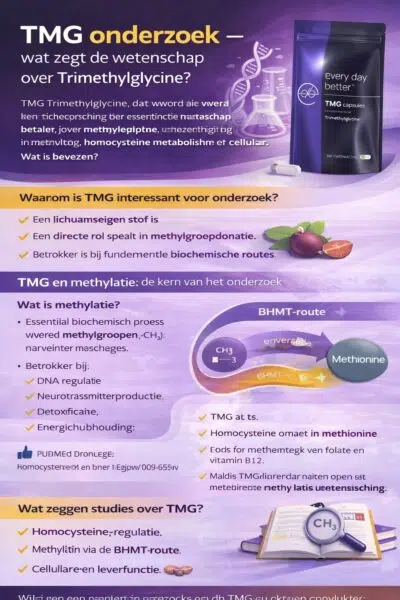
TMG (Trimethylglycine), also known as betaine, is a substance that occurs naturally in the human body and in food. In scientific literature, TMG has been studied for decades, particularly for its role in methylation, homocysteine metabolism, and cellular balance.
But what do we really know from research?
Which effects are well-substantiated, and where is nuance needed?
On this page, we present the scientific research on TMG in a clear and honest manner.
👉 New to TMG? Read first: How does TMG work?
Why is TMG interesting for scientific research?
TMG is interesting because it:
- Is a naturally occurring substance
- Plays a direct role in methyl group donation
- Is involved in fundamental biochemical pathways
The focus of research is mainly on:
- Homocysteine → methionine conversion
- Support of methylation via the BHMT pathway
- Liver and cell metabolism
📚 PubMed Overview – https://pmc.ncbi.nlm.nih.gov/articles/PMC12300400/
TMG and methylation: the core of the research
What is methylation?
Methylation is an essential biochemical process in which methyl groups (-CH₃) are transferred. This process is involved in:
- DNA regulation
- Neurotransmitter production
- Detoxification
- Energy management
TMG acts as a direct methyl group donor in this process.
The BHMT pathway (betaine-homocysteine methyltransferase)
A large part of TMG research focuses on the BHMT pathway, in which TMG:
- Converts homocysteine to methionine
- Does this independently of folate and vitamin B12
This makes TMG particularly interesting as additional methylation support.
TMG and homocysteine – what does research show?
One of the most consistent findings in research is that TMG:
- Can lower homocysteine
- This effect is dose-dependent
- Is especially visible with elevated baseline values
Why is homocysteine relevant?
Homocysteine is an intermediate product in the methionine cycle. Too high levels are associated with disruption of cellular processes in research.
TMG, liver function and fat metabolism
In animal and human studies, TMG is also being investigated in relation to:
- Liver metabolism
- Lipid metabolism
- Osmoregulation
TMG functions as follows in liver cells:
- Osmolyte (protection against cellular stress)
- Methyl group donor in liver processes
TMG and sports and performance research
In sports science, betaine (TMG) is being investigated for possible effects on:
- Muscle endurance
- Hydration of cells
- Strength output
Results are mixed, but show that TMG:
- Can influence the cellular hydration status
- Supports performance parameters in some studies
📚 Sports Nutrition review: https://pubmed.ncbi.nlm.nih.gov/21346616/
TMG and cognitive processes
Indirectly, TMG is also being investigated for its role in:
- Neurotransmitter balance (via methylation)
- Methionine and SAMe availability
There are no hard cognitive claims, but TMG is mentioned in studies as part of broader methylation studies.
👉 You can also read context about this in: Cellular energy & recovery
TMG in combination with B vitamins (research perspective)
Research shows that:
- B6, B12 and folate support methylation via the methionine cycle
- TMG uses a parallel route
This explains why TMG is often used in studies:
- Is combined with B vitamins
- Is used for folate-independent methylation
📚 PubMed – combined pathways: https://pubmed.ncbi.nlm.nih.gov/12600851/
TMG, NMN and NAD⁺ – indirect research relationship
Although TMG does not directly increase NAD⁺, there is growing interest in:
- Methylation load with increased NAD⁺ activity
- Balance between NAD⁺ pathways and methyl group availability
Therefore, TMG is often mentioned alongside NMN in practice.
👉 See also: NMN supplements
What does the EFSA say about TMG?
The European Food Safety Authority (EFSA) has assessed betaine for safety.
Conclusions:
- TMG is safe within common intakes
- No evidence of toxicity at usual dosages
- Broadly applicable within a nutritional context
TMG and safety in research
Research shows that:
- TMG is well tolerated
- Side effects are usually mild and dose-dependent
- Long-term use is prevented in studies
👉 Fully explained here: TMG side effects
Limitations of current TMG research
Important for EEAT: not everything is proven.
Limitations:
- Many studies are short-term
- Variation in dosage and populations
- Some effects are context-dependent
Therefore, TMG is:
- Not a miracle ingredient
- But a well-researched biochemical building block
TMG research summarized
| Research theme | Conclusion |
|---|---|
| Methylation | Well substantiated |
| Homocysteine | Consistent effect |
| Liver metabolism | Promising |
| Sports performance | Mixed |
| Cognition | Indirect |
| Safety | Good profile |
How does research translate into practical use?
In practice, this means:
- Use TMG within common dosages
- Combine consciously with other supplements
- See TMG as part of a system, not as a separate solution
Read more within the TMG topic
- 👉 How does TMG work?
- 👉 TMG dosage
- 👉 TMG side effects
- 👉 GlyNAC vs NAC
- 👉 TMG supplement – Every Day Better
Infographic about scientific research into TMG (Trimethylglycine), with explanation about methylation, homocysteine and biochemical pathways.

