
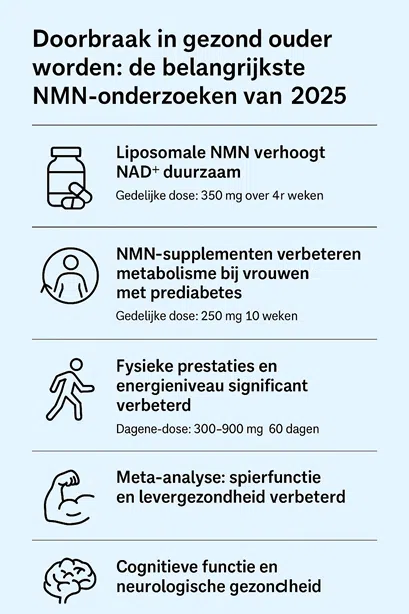
NMN surveys from 2025
By 2025, significant scientific breakthroughs have been made in the field of NMN (nicotinamide mononucleotide), a molecule that acts as a precursor to NAD+ and has potential in the field of healthy aging. This blog provides an in-depth analysis of the latest clinical NMN studies, supported by leading institutions worldwide. We discuss how NMN supplements work, the link to NAD+, dosages, side effects and why the supplement is attracting increasing interest from researchers and users alike.
What is NMN and why is it important?
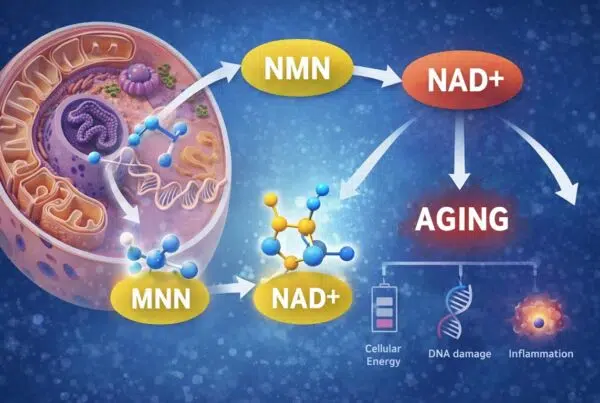
Nicotinamide mononucleotide (NMN) is a molecule that is converted in the body to NAD+ (nicotinamide adenine dinucleotide), an essential coenzyme involved in hundreds of processes such as cell repair, DNA repair, energy metabolism and mitochondrial function. As we age, levels of NAD+ decrease dramatically, which is linked to decreased energy, mental clarity and cellular health.
NMN is considered one of the most potent precursors of NAD+ and has already shown promising results in animal models. Since 2016, it has also been tested on humans, and the 2025 NMN studies mark a clear tipping point in the clinical substantiation of the efficacy and safety of NMN supplements.
Key NMN research from 2025
Liposomal NMN increases NAD⁺ sustainable
A randomized, double-blind study conducted in the US examined the effect of a daily dose of 350 mg liposomal NMN for four weeks in healthy adults aged 40 to 65 years. The results were remarkable: not only did NAD⁺ levels increase significantly in all participants, but this increase remained present for four weeks after stopping intake.
Liposomal NMN utilizes a fat-like protective layer that protects the molecule from degradation in the digestive tract, resulting in much higher bioavailability than standard NMN powder. This study highlights the importance of form and uptake technology in NMN supplementation.
NMN supplements improve metabolism in women with prediabetes
Researchers at Washington University School of Medicine conducted a clinical trial with postmenopausal women who were overweight and had insulin resistance. For 10 weeks, the women received a daily dose of 250 mg NMN. The study showed that:
- Insulin sensitivity significantly improved in skeletal muscle.
- There was no change in weight or fat mass (i.e., effect independent of weight loss).
- Energy metabolism at the cellular level became more active.
This study confirms that NMN plays a role not only in healthy aging, but also in preventing metabolic syndrome and type 2 diabetes.
Physical performance and energy levels significantly improved
A double-blind, placebo-controlled study was conducted in Japan on 108 healthy adults divided into three dosage groups (300 mg, 600 mg and 900 mg per day). Participants took the NMN supplement for 60 days. It is one of several NMN studies from 2025.
Results:
- The greatest improvement in physical performance and fatigue scores occurred in the 600 mg group.
- In the 6-minute walk test, endurance improved an average of 12%.
- Participants themselves reported feeling mentally sharper, physically fitter and more emotionally stable.
This study shows that NMN is valuable not only for the elderly, but also for active adults who want to optimize their energy levels and performance.
Meta-analysis: muscle function and liver health improved
An international group of scientists analyzed nine NMN clinical studies with a total of 412 participants between the ages of 40 and 80. This meta-analysis concluded:
- Walking speed increased by an average of 10-20%, especially in 40-60-year-olds.
- Liver enzymes such as ALT decreased by 15%, indicating improved liver function.
- No serious side effects reported.
This confirms the broad impact of NMN on range of motion, muscle strength and detoxification processes in the body.
Cognitive function and neurological health
Although the 2025 NMN research still focused primarily on physical functioning, preliminary results have also been published on NMN’s role in improving cognitive performance.
In mouse models, NMN was shown to cross the blood-brain barrier and restore NAD⁺ levels in brain tissue. This reduces inflammation, enhances mitochondrial function and delays cognitive decline. Studies in humans are expected in 2026.
Safety and side effects of NMN
NMN is considered safe at doses between 250 and 900 mg per day. All recent studies show:
- No serious side effects.
- Some mild symptoms such as mild digestive problems (avoidable by taking NMN with food).
- No negative interactions with other supplements or medications reported.
Long-term long-term safety is currently being investigated in an ongoing cohort study with more than 500 participants worldwide.
How to choose the best NMN supplement?
If you are considering Buying NMN, it is important to pay attention to the following points:
- Form: Liposomal NMN is more effective than standard NMN.
- Purity: Choose a product with at least 98% pure NMN.
- Origin: Ideally produced in Europe or the U.S. under GMP certification.
- Transparency: See if the brand makes test results (COA) available.
NMN and biohacking: the future of personal health
In the world of biohacking, NMN is often taken together with resveratrol, PQQ, coenzyme Q10 or TMG (trimethylglycine) to achieve a synergistic effect on energy, cell renewal and aging processes. In the process, many users also monitor their NAD⁺ levels with home kits.
The 2025 NMN developments bring this supplement closer to mainstream application, thanks in part to the scientific rationale that is growing stronger.
Conclusion: is NMN research from 2025 a breakthrough or hype?
Given the clinical evidence, the safety profile and the surge in human studies, NMN no longer appears to be just hype in 2025, but a full-fledged anti-aging supplement that will eventually play an important role in healthcare.
Resources
- Yi L, et al. The efficacy and safety of β-nicotinamide mononucleotide (NMN) supplementation in healthy middle-aged adults: a randomized, multicenter, double-blind, placebo-controlled, parallel-group, dose-dependent clinical trial. GeroScience (2023). SpringerLink PDF
- Yoshino J, et al. Nicotinamide mononucleotide increases muscle insulin sensitivity in prediabetic women. Science (2021). Science.org
- Igarashi M, et al. Nicotinamide mononucleotide (NMN) supplementation enhances aerobic capacity in healthy older men. Endocrine Journal (2023). J-STAGE
- Guo R, et al. The clinical evidence of nicotinamide mononucleotide supplementation on NAD+ metabolism and cardiometabolic health: a systematic review and meta-analysis of randomized controlled trials. Current Diabetes Reports (2024). Springer
- Safety trial favors high-dose NMN supplementation (1,500 mg/day). Renue By Science. RenueByScience.com
- Mills KF, et al. Long-term oral administration of NMN mitigates age-associated physiological decline in mice. Cell Metabolism (2016). Cell Metabolism.
- Nicotinamide mononucleotide in human trials. NIH PubMed. PubMed