

Why sleep optimization and NMN belong together
Everyone knows that a good night’s sleep is essential. But what exactly happens in your body during those hours of deep sleep? Recent research shows that sleep not only gives back energy, but also determines the quality of your cellular repair processes. Here the circadian rhythm – our internal biological clock – plays a crucial role.
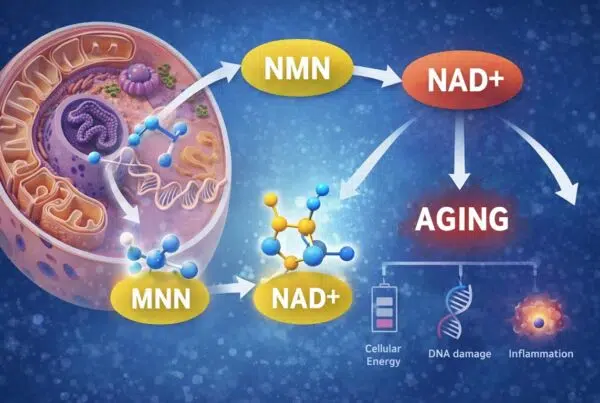
At the same time, there is growing interest in NMN (nicotinamide mononucleotide) as a supplement to stimulate the natural production of NAD⁺. NAD⁺ is a coenzyme indispensable for energy production, DNA repair and slowing down aging processes. The combination of optimized sleep optimization, circadian balance and NMN supplementation proves particularly powerful for those who want to age vitally.
In this blog, we dive deep:
- How sleep and circadian rhythms work
- Why NAD⁺ is crucial to recovery
- How NMN supports this process
- Practical strategies to optimize sleep
- Scientific evidence and user experiences
1. The circadian rhythm: your biological clock
The circadian rhythm is a 24-hour cycle that your body uses to coordinate processes such as:
- Sleep-wake rhythm
- Hormone production (melatonin, cortisol, growth hormone)
- Digestion and metabolism
- Cell repair and DNA repair
This rhythm is controlled by the suprachiasmatic nucleus (SCN) in the brain, which is sensitive to light and dark. Therefore, factors such as sunlight, artificial light, screen use and feeding times strongly influence your biological clock.
👉 Problem of our time: Modern lifestyles – staying up late, blue light from screens, irregular working hours – disrupt this rhythm. Result: poorer sleep quality, reduced cellular repair and faster aging.
2. Sleep optimization as a foundation for cellular repair
During the night, your body goes through different stages of sleep:
- NREM sleep (light sleep)
The body begins to relax, heart rate and breathing slow down. - Deep sleep (slow-wave sleep)
Crucial for physical recovery: growth hormone is released, muscles and tissues recover, immune system strengthened. - REM sleep (dream sleep)
Important for memory, emotional processing and creativity.
During deep sleep, increased DNA repair and autophagy take place – processes that clean up and rejuvenate damaged cells. For these processes, NAD⁺ is indispensable.
3. NAD⁺: the molecule that connects everything
NAD⁺ (nicotinamide adenine dinucleotide) is a coenzyme present in every cell. Without NAD⁺, our mitochondria – the cell’s power plants – do not function properly. Main functions:
- Energy production (ATP)
- DNA repair via sirtuins and PARP enzymes
- Regulation of circadian rhythms via clock genes
- Supporting stress response and cell survival
👉 Problem: NAD⁺ levels decrease with age and due to stress, poor diet or sleep deprivation. This accelerates aging and reduces the effectiveness of sleep recovery.
4. How NMN replenishes the NAD⁺ stockpile.
NMN is a direct precursor of NAD⁺. Taking NMN allows the body to restore NAD⁺ levels. Clinical and preclinical studies show:
- Improved energy metabolism
- Support of cognitive functions
- Stimulation of DNA repair
- Extension of lifespan in animal models
In addition, it appears that NAD⁺ levels fluctuate circadian: they are higher during the day and lower at night. NMN may help stabilize this rhythm, further enhancing its synergy with sleep.
5. The synergy: sleep optimization+ circadian rhythm + NMN
When sleep and circadian rhythms function optimally as well as NAD⁺ levels are sufficiently high, a powerful recovery mechanism emerges:
- During deep sleep, sirtuins perform DNA repair – this requires NAD⁺.
- Circadian clock genes regulate these processes; NAD⁺ acts as fuel.
- NMN replenishment maintains the required NAD⁺ supply.
👉 Result: better sleep, more efficient cellular repair, more energy during the day and delay of aging symptoms.
6. Scientific evidence sleep optimization
Some important studies:
On sleep optimization & circadian rhythms
- Harvard Medical School – explaining circadian rhythms:
https://www.health.harvard.edu/staying-healthy/what-is-circadian-rhythm - National Institute of General Medical Sciences – biological clock and health:
https://www.nigms.nih.gov/education/fact-sheets/Pages/circadian-rhythms.aspx
About NAD⁺ and NMN
- Nature Communications (2018) – NAD⁺ precursors and vascular function in the elderly:
https://www.nature.com/articles/s41467-018-03421-7 - Frontiers in Aging (2023 review) – NAD⁺, aging and lifestyle factors:
https://www.frontiersin.org/journals/aging
7. Practical tips for sleep optimization
In addition to NMN, there are numerous strategies to improve your sleep and circadian rhythm:
During the day
- Sunlight in the morning: stimulates cortisol and sets your clock right.
- Exercise: preferably outdoors, to promote melatonin production in the evening.
- Limit caffeine: last coffee before 2 p.m.
In the evening
- Avoiding blue light: screen filter or glasses.
- Regular sleep rhythm: go to bed around the same time every day.
- Evening ritual: reading, breathing exercises, meditation.
Sleep environment
- Dark and cool (16-18°C)
- No noise or distractions
- Comfortable bed and pillow
8. When to take NMN?
Time of ingestion can be crucial:
- Morning intake: joins natural NAD⁺ peak and can provide energy and focus.
- Evening intake: some users report improved sleep quality, but research is limited.
👉 Advice: start with morning intake, observe effects, and experiment with timing if necessary.
9. Stories of Experience
Many users of NMN report:
- Deeper sleep and waking up rested.
- Less night waking.
- Improved focus and mood during the day.
Although anecdotal, this fits well with the mechanism of NAD⁺ and sleep regulation.
10. Conclusion
Sleep optimization and circadian rhythms are the foundation of healthy aging. By combining this with NMN supplementation, you support your body with extra fuel for DNA repair, energy production and cell renewal. It is the synergy of natural rhythm and modern science that can make the difference.
11. Practical checklist
- Provide regularity in sleep and wake times.
- Avoid blue light and caffeine in the evening.
- Optimize your bedroom environment.
- Consider NMN supplementation, start with morning intake.
- Combine with healthy eating, exercise and stress reduction.