

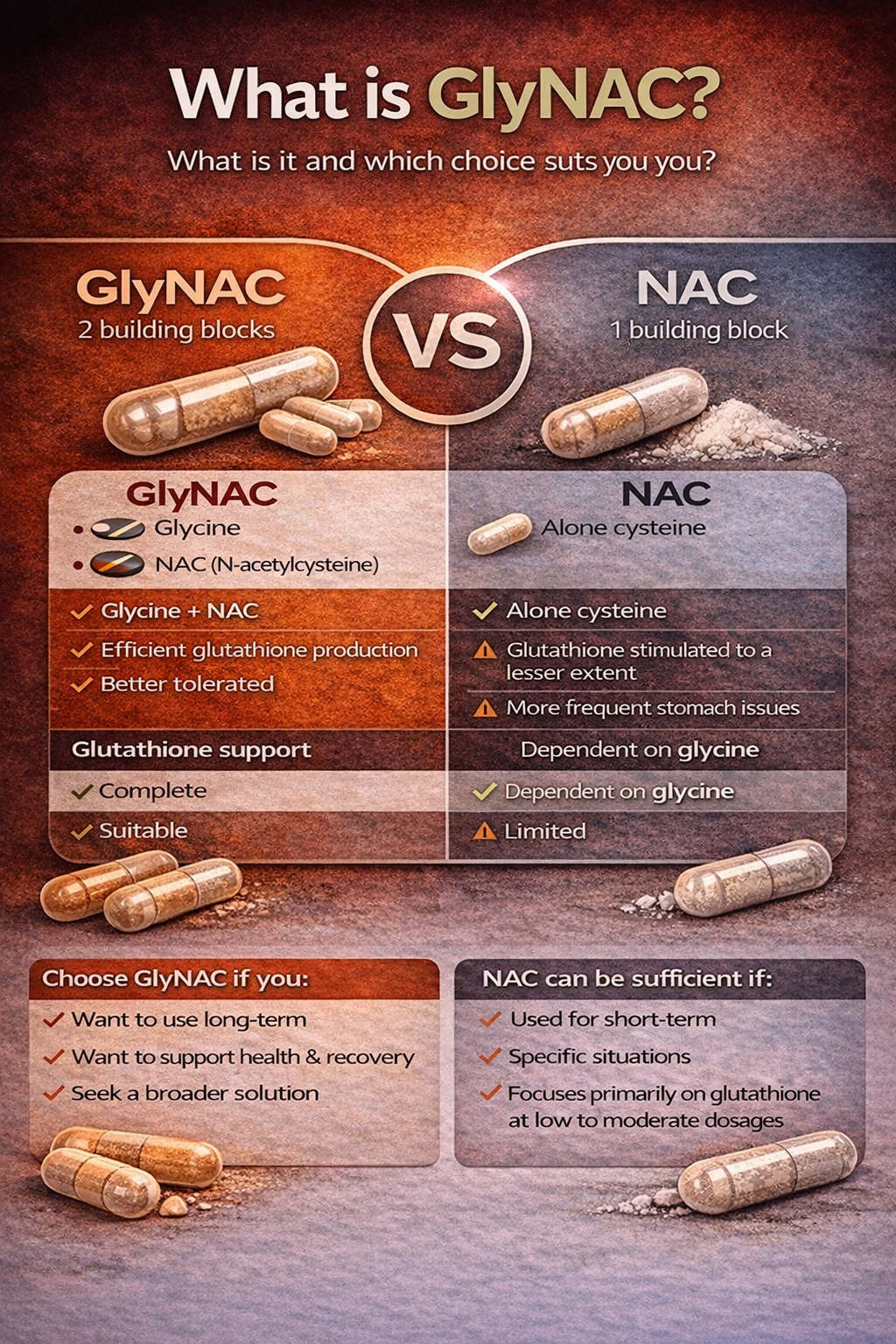
What is GlyNAC? Benefits, dosage, side effects, and comparison with NAC, glutathione, and NMN
At Every Day Better, we view GlyNAC as one of the most interesting combinations within healthy aging, cellular health, and vitality. Interest in topics such as what is GlyNAC, GlyNAC benefits, GlyNAC dosage, GlyNAC side effects, and GlyNAC vs NMN is growing rapidly.
This is logical. GlyNAC aligns with key themes in longevity, such as glutathione production, oxidative stress, mitochondrial health, recovery capacity, and healthy aging.
What makes GlyNAC particularly relevant is that it is not about hype, but about a biological mechanism that is easy to understand. At the same time, we believe it is important to remain honest: the initial research results are promising, but the science is still fully in development.
That is why at Every Day Better, we choose a clear approach. No miracle claims, but clear explanations of what GlyNAC is, what GlyNAC does, how to use GlyNAC, and what to look out for regarding dosage and safety.
Want to understand the basics first? Then read How does GlyNAC work? Explanation of glycine, NAC, and glutathione or view our overview of GlyNAC research.
What is GlyNAC?
GlyNAC is a combination of glycine and N-acetylcysteine (NAC). It is therefore not a single substance, but a targeted combination of two building blocks that can support the body in the production of glutathione. Glutathione is an endogenous antioxidant that plays an important role in protecting against oxidative stress and supporting cellular balance.
The name GlyNAC therefore simply stands for: GlyNAC = glycine + NAC. This distinction is important because GlyNAC is different from just NAC, just glycine, or a supplement containing direct glutathione.

What is GlyNAC good for?
A frequently asked question is: what is GlyNAC good for? Or: what does GlyNAC do in your body? Based on current research, GlyNAC is primarily discussed in relation to:
- supporting glutathione status
- balance in oxidative stress
- supporting mitochondrial function
- metabolic resilience
- healthy aging and cellular vitality
In a well-known clinical study in older adults, improvements were seen in markers associated with glutathione deficiency, oxidative stress, mitochondrial dysfunction, inflammation, and physical function. These results have ensured that GlyNAC is increasingly mentioned within the world of longevity and healthy aging.
You can find more in-depth information on this on our page about GlyNAC research.
Benefits of GlyNAC
Those searching for GlyNAC benefits primarily want to know which effects emerge from research. The most cautious and honest conclusion is that GlyNAC potentially offers support for:
- glutathione production
- oxidative balance
- mitochondrial health
- metabolic support
- certain aspects of physical vitality
Interesting signals for this have been found, particularly in older adults. However, it is important to remain realistic. GlyNAC is currently not proven as a miracle cure for aging, fatigue, or other broad health claims.
We therefore see GlyNAC as a promising combination with a strong scientific basis, but not as a magic solution.
How does GlyNAC work?
The mechanism of GlyNAC primarily revolves around supporting the body’s own production of glutathione. For this production, the body requires various amino acids. Glycine provides part of these building blocks and NAC helps the body obtain cysteine, another important component in this process. This combination makes GlyNAC interesting for people who are focused on cellular health, recovery, and healthy aging.
Read also: How does GlyNAC work?
GlyNAC dosage: how much GlyNAC per day?
Searches such as GlyNAC dosage, how much GlyNAC per day, and GlyNAC recommended dose show that many people primarily want to know practically how to use GlyNAC.
Various dosage protocols have been used in human studies. In an important study in older adults, participants received:
100 mg/kg/day glycine + 100 mg/kg/day NAC
In another study in healthy older adults, total daily dosages were tested of:
- 2.4 grams per day
- 4.8 grams per day
- 7.2 grams per day
Important to note: there is currently no official universal guideline for a single fixed GlyNAC dosage that applies to everyone.
The right choice depends on factors including:
- body weight
- total composition of the supplement
- ratio between glycine and NAC
- personal sensitivity
- medication or medical situation
You can find more practical explanations on our page GlyNAC dosage: how much do you need and when?.
When is the best time to take GlyNAC?
Questions such as when to take GlyNAC and what is the best time to take GlyNAC also frequently recur. Current studies focus primarily on total daily intake rather than a perfect time in the morning or evening. In practice, consistent use seems more important than the exact moment of intake.
Because GlyNAC contains NAC, some people may find it more pleasant to take the supplement with a meal, especially if they have a sensitive stomach.
GlyNAC side effects
If you are searching for GlyNAC side effects, it is good to know that in short-term human studies, GlyNAC is generally described as safe and well-tolerated. The most likely complaints are related to the NAC component. These primarily include:
- mild stomach complaints
- intestinal complaints
- nausea at higher dosages
This does not mean that everyone will experience these, but it is advisable to build up slowly when starting GlyNAC for the first time.
You can read more about this on GlyNAC research.
Is GlyNAC safe?
The question ‘is GlyNAC safe?’ is logical. Based on current human studies, the answer is that GlyNAC generally appears safe and well-tolerated in the short term. At the same time, data on long-term daily use are still limited. Therefore, we believe it is important to approach GlyNAC responsibly.
Because GlyNAC contains NAC, broader information about NAC is also relevant. For example, the RIVM has paid attention to the safety of NAC in supplements and advises consumers to pay close attention to their total daily intake.
For whom is GlyNAC interesting?
GlyNAC can be particularly interesting for adults who are consciously focused on:
- healthy ageing
- glutathione support
- oxidative balance
- cellular resilience
- vitality at the cellular level
Older adults are the most studied target group in current research. This does not automatically mean that GlyNAC is necessary for everyone. Relevance always depends on personal context, lifestyle, and health goals.
Also view our product page: GlyNAC Capsules | Glycine & NAC supplement.
Who should avoid using GlyNAC?
For some people, extra caution is advisable. Consult a physician or healthcare professional first if you:
- are pregnant
- are breastfeeding
- use medication
- have surgery planned
- have a complex medical condition
This caution is particularly important because NAC can have interactions and is not equally suitable for every situation.
GlyNAC vs NAC: what is the difference?
One of the most searched comparisons is GlyNAC vs NAC.
The main difference is this:
- NAC primarily supports the availability of cysteine
- GlyNAC combines NAC with glycine and therefore offers broader support for the building blocks of glutathione
From a biological perspective, GlyNAC is therefore more broadly designed than NAC alone. However, direct comparative human research between GlyNAC and NAC alone is still limited.
Read also: GlyNAC vs NAC.
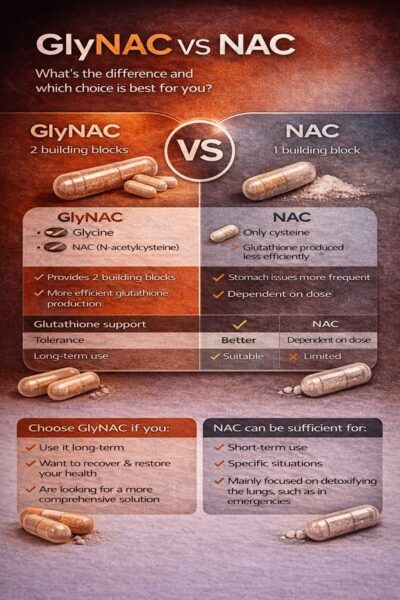
Comparison between GlyNAC vs NAC with the main differences in composition and mechanism
GlyNAC vs glutathione
Many people wonder whether it is better to take glutathione directly or to choose a supplement that supports the body’s own production.
GlyNAC is particularly interesting as a precursor strategy. This means it does not provide glutathione itself, but supports the body with the building blocks necessary for its own production.
For many people, this is precisely an interesting approach within a broader focus on cellular health.
GlyNAC vs NMN
We also see the comparison GlyNAC vs NMN more and more frequently.
Although both supplements are often discussed within longevity, they target different biological systems.
- GlyNAC is primarily linked to glutathione, oxidative stress, and mitochondrial resilience
- NMN is primarily discussed as a precursor to NAD+ and cellular energy production
There is currently no strong direct human study demonstrating that GlyNAC is better than NMN or vice versa. The most honest conclusion is therefore that they can each play a different role within a broader longevity strategy.
Read more about this in Longevity at the cellular level: NMN, TMG & GlyNAC compared.
What should you look for in a good GlyNAC supplement?
Those searching for the best GlyNAC supplement or where to buy GlyNAC usually want to know not only what GlyNAC is, but also how to recognize quality.
In our view, a good GlyNAC supplement is characterized by:
- a clear composition
- transparent dosage
- a clear ratio between glycine and NAC
- practical usage information
- a focus on quality and purity
View our current GlyNAC product pages via GlyNAC Capsules and GlyNAC Capsules 60×600 mg.
How long does it take for GlyNAC to work?
Those searching for how long it takes for GlyNAC to work are usually looking for a concrete timeframe. The most important studies ran for weeks, not days. One of the best-known studies used a period of 16 weeks.
This suggests that GlyNAC primarily fits within an approach of consistent long-term use, rather than the idea of a quick short-term solution.
Is GlyNAC worth it?
Our honest view is that GlyNAC is one of the more interesting combinations within the domain of healthy aging and cellular support. The combination is scientifically logical, aligns with an important endogenous system, and has shown initial positive results in human studies. At the same time, research is not yet complete and we believe it is important to maintain realistic expectations.
Therefore, we see GlyNAC as:
- scientifically interesting
- promising within longevity
- relevant for glutathione support
- not a miracle cure
Would you like to read further? Then also view:
Frequently asked questions about GlyNAC
- What is GlyNAC?
GlyNAC is a combination of glycine and N-acetylcysteine (NAC). This combination is used to support the body’s own production of glutathione. - What is GlyNAC good for?
GlyNAC is primarily discussed in relation to glutathione, oxidative stress, mitochondrial health, and healthy aging. - What is the best GlyNAC dosage?
There is no universal standard dosage for everyone. Various dosages have been used in studies, depending on the design and target group. - When is the best time to take GlyNAC?
In practice, consistency appears more important than timing. Many people take GlyNAC with a meal. - Does GlyNAC have side effects?
Possible side effects are primarily related to NAC and may consist of mild stomach or intestinal complaints. - Is GlyNAC safe?
Short-term human research shows that GlyNAC is generally well-tolerated, although caution remains important for long-term use and personal medical situations. - What is the difference between GlyNAC and NAC?
NAC primarily provides cysteine, while GlyNAC combines glycine + NAC and thus focuses more broadly on supporting glutathione production. - What is the difference between GlyNAC and NMN?
GlyNAC and NMN target different systems. GlyNAC is primarily linked to glutathione and oxidative stress, while NMN revolves around NAD+ and cellular energy. - Where can you purchase a high-quality GlyNAC supplement?
Please refer to our current product pages: GlyNAC Capsules and GlyNAC Capsules 60×600 mg.
External sources
- Sekhar RV, Patel SG, Guthikonda AP, et al.
Supplementing Glycine and N-Acetylcysteine (GlyNAC) in Older Adults Improves Glutathione Deficiency, Oxidative Stress, Mitochondrial Dysfunction, Inflammation, Insulin Resistance, Endothelial Dysfunction, Genotoxicity, Muscle Strength, and Cognition: Results of a Pilot Clinical Trial.
Clinical and Translational Medicine.
https://onlinelibrary.wiley.com/doi/epdf/10.1002/ctm2.372 - Kumar P, Liu C, Suliburska J, et al.
Supplementing Glycine and N-Acetylcysteine (GlyNAC) in Older Adults Improves Glutathione Deficiency, Oxidative Stress, Mitochondrial Dysfunction, Insulin Resistance, Physical Function, and Aging Hallmarks: A Randomized Clinical Trial.
The Journals of Gerontology: Series A.
https://academic.oup.com/biomedgerontology/article/78/1/75/6668639 - McCaddon A, Regland B, Hudson P, Davies G.
A Randomized Controlled Clinical Trial in Healthy Older Adults to Determine Efficacy of Glycine and N-Acetylcysteine Supplementation on Glutathione Redox Status and Oxidative Damage.
Frontiers in Aging.
https://www.frontiersin.org/journals/aging/articles/10.3389/fragi.2022.852569/full - RIVM.
Risk assessment of food supplements containing N-acetylcysteine (NAC).
National Institute for Public Health and the Environment.
https://www.rivm.nl/publicaties/risk-assessment-food-supplements-containing-n-acetylcysteine


