
Biochemical survival for young parents – Blog 4
As a young parent, everything revolves around the here and now. Sleep deprivation, diapers, work, housework. But among all the hectic activity, you may be asking yourself a deeper question: “How do I really stay there for my children – not just today, but 10, 20 or 30 years from now?“
Staying healthy is more than “not being sick.” It’s about vitality, presence and resilience. That’s what healthspan is all about: how long can you stay healthy, sharp and energetic for yourself and your family?
Why is this question so important?
Children grow quickly. But you are also aging in the meantime. And how you handle stress, sleep, nutrition and exercise now will affect how you function in the future.
The good news? You don’t have to be a marathon runner or biohacker to structurally support your health. You just need to understand how your body works – and respond to it with small actions.
Healthspan vs Lifespan: what really counts?
Your lifespan is how long you live.
Your healthspan is how long you stay vital.
For example: you can live to be 85, but if you’re chronically tired from age 60, have physical complaints and are mentally out of focus, that time doesn’t feel like living.
Goal: as many healthy years as possible – in which you participate, play along, talk along and keep up.
What happens biologically as you age?
1. NAD+ level decreases
NAD+ is essential for cellular energy, DNA repair and inhibiting aging processes. But your natural NAD+ production declines after age 30 – and it accelerates due to stress, sleep deprivation and nutritional deficiencies.
2. Mitochondria lose power
Your cells make energy in tiny power plants: mitochondria. The older you get, the less efficient they work.
Result: faster fatigue, slower recovery processes, decline in cognitive functions.
3. Ignition levels rise
Low-grade inflammation (inflammaging) is considered one of the drivers of aging. It disrupts energy production, immune response and repair capacity.
How can NMN contribute to your long-term health?
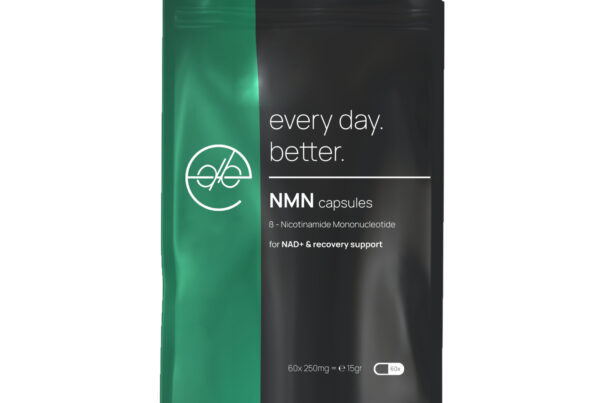
NMN (nicotinamide mononucleotide) is a direct precursor of NAD+. By taking NMN daily, you support your cells in making NAD+, which contributes to:
✔ Better energy metabolism
✔ DNA repair
✔ Support of cardiovascular health
✔ Activation of sirtuins – proteins that regulate cell aging
Studies have shown that NMN supplementation in mice led to improved insulin sensitivity, improved vascular health and increased physical performance.¹
Want to know how NMN works? Read it here → How does NMN work?
Realistic health strategy for parents
You don’t have time for 2 hours of exercise a day. Nor do you need to. Here’s a viable approach for parents:
1. Build a 10-minute morning routine
– 5 min stretching or light exercise
– 1 glass of water with electrolytes
– NMN + possibly magnesium or omega-3
– 1 conscious breathing exercise or intention setting
2. Choose nutritious basics
– Eat protein with every meal
– Avoid spikes in blood sugar (do not skip breakfast)
– Add vegetables, healthy fats and fiber daily
3. Move functionally
– Walking with the stroller
– Squats while your baby sits on your lap
– Taking stairs, stretching before bed
Small movement = big long-term gain
4. Use stress buffers
– Magnesium (L-threonate or bisglycinate)
– Adaptogens such as rhodiola or ashwagandha
– Setting limits to digital stimuli
5. Supplement smartly
– NMN (for NAD+)
– Omega-3 (for brain function)
– Vitamin D (for immune function)
– B vitamins (for energy production)
Think in terms of “rememberable energy”
Your child won’t remember how much you worked, but he or she will remember how often you were there.
By investing in a fundamentally healthy foundation now, you ensure that you will have the strength to play together, talk, travel or just be present later.
Summary: What can you do?
What’s going on?
Your health is changing under the influence of stress, aging and family strain.
What’s happening biologically?
NAD+ levels drop, mitochondria weaken, inflammation rises.
What can you realistically do?
Exercise, repair, nourish, protect.
How does NMN help?
Supports NAD+, cellular energy, repair and aging inhibition.
Next step?
Check out the full range of NMN supplements at EveryDayBetter →
📚 Sources
¹ Mills KF, Yoshida S, et al. (2016). Long-Term Administration of Nicotinamide Mononucleotide Mitigates Age-Associated Physiological Decline in Mice. Cell Metabolism