
NMN and Hair Growth in 2026
Hair loss affects more people than is often thought. Both men and women notice their hair thinning as they age. Consequently, the search for solutions goes beyond just shampoos or classic medication. In recent years, there has been increasing focus on cellular health as the foundation of hair preservation. Within this development, NMN (nicotinamide mononucleotide) has become an interesting area of research.
Wie zich eerst wil verdiepen in de basis kan lezen wat NMN precies is en hoe het werkt via onze uitgebreide uitleg over NMN: https://everydaybetter.nl/wat-is-nmn/
In 2025 and 2026, new scientific publications appeared looking at the relationship between NAD⁺, aging, and hair follicles. In this article, we discuss what we currently know for certain, what remains uncertain, and how NMN might play a role within a broader strategy for hair health.
Why NAD⁺ is Important for Hair Follicles
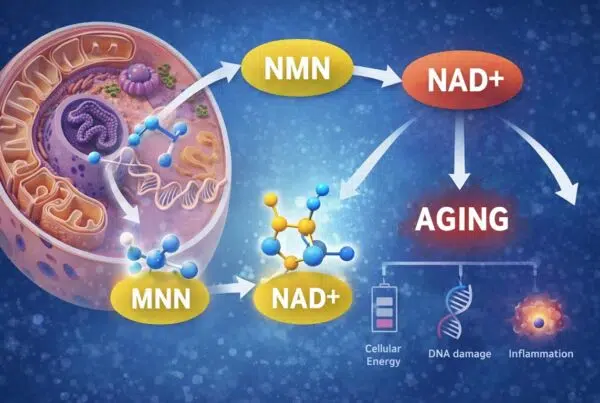
To understand why NMN and hair growth in 2026 may be relevant to hair growth, we must first examine NAD⁺. This molecule is essential for energy production within our cells. Hair follicles are among the most active cells in the body. They divide continuously during the hair’s growth phase, also known as the anagen phase. This process requires significant energy and a well-functioning DNA repair mechanism.
Met het ouder worden dalen NAD⁺ niveaus in verschillende weefsels. Dit mechanisme is uitgebreid beschreven in wetenschappelijke publicaties over NAD⁺ en veroudering, bijvoorbeeld via PubMed: https://pubmed.ncbi.nlm.nih.gov/29608132/
Lower NAD⁺ levels are associated with reduced mitochondrial function, higher oxidative stress, and slower cell renewal. In theory, this can also have consequences for hair follicles, which are highly dependent on an optimal energy supply.
In onze complete NMN gids leggen we uit hoe NAD⁺ samenhangt met verouderingsprocessen in verschillende weefsels: https://everydaybetter.nl/complete-nmn-gids/
NMN is a direct precursor to NAD⁺. Through supplementation, the body can produce NAD⁺ more efficiently. This mechanism is central to nearly all studies on NMN.
New clinical study on NMN and hair growth in 2026 among women
In 2025 verscheen een klinische studie in het tijdschrift Cosmetics waarin onderzoekers de effecten van orale NMN-suppletie onderzochten bij vrouwen tussen de 40 en 50 jaar. De publicatie is vrij toegankelijk via MDPI: https://www.mdpi.com/2079-9284/12/5/204
Participants were administered NMN for twelve weeks. The researchers measured hair density, hair diameter, and the ratio between hairs in the growth phase and the resting phase.
The results were cautiously positive. An increase was observed in the percentage of hairs in the anagen phase. Additionally, the average hair diameter increased. This suggests that the follicles became more active and potentially functioned more robustly. Importantly, hormonal values did not change significantly, indicating that the effect was likely not hormonally driven but rather metabolic or cellular in nature.
The study was small-scale and not placebo-controlled. This means we must be careful with conclusions. Nevertheless, it is relevant that human data specifically looking at hair parameters in relation to NMN are available for the first time.
Mechanisms That May Play a Role
Haarfollikels hebben goed werkende mitochondriën nodig voor ATP-productie. NAD⁺ is cruciaal voor deze energieproductie. Reviewartikelen over mitochondriale veroudering en NAD⁺ zijn onder andere te vinden via PubMed: https://pubmed.ncbi.nlm.nih.gov/33468552/
Daarnaast speelt oxidatieve stress een rol. Vrije radicalen kunnen schade veroorzaken aan follikelcellen. NAD⁺ activeert sirtuïnes, eiwitten die betrokken zijn bij celbescherming en stressregulatie. In wetenschappelijke reviews zoals gepubliceerd in Molecules wordt de relatie tussen NAD⁺ en huidveroudering verder uitgediept: https://www.mdpi.com/1420-3049/29/4/798
Tot slot is DNA-herstel relevant. Haarfollikels bevatten snel delende cellen. NAD⁺ is noodzakelijk voor PARP-enzymen die betrokken zijn bij DNA-herstelprocessen. Meer achtergrond over deze rol van NAD⁺ lees je in onze verdieping over de werking van NMN: https://everydaybetter.nl/nmn-werking/
While these mechanisms are biologically plausible, it does not yet mean that every individual will experience visible hair growth.
What the research on NMN and hair growth in 2026 says so far
In 2026, several review articles were published discussing the role of NAD⁺ in skin aging and hair biology. The consensus is that NAD⁺ decline is a hallmark of aging and that restoring these levels can potentially offer benefits for metabolically active tissues such as skin and hair.
What is missing, however, are large randomized placebo-controlled studies with hundreds of participants. Until then, we must speak of promising early data, not proven therapy.
It is also important to distinguish between different forms of hair loss. Androgenetic alopecia is largely influenced by DHT. NMN is not a DHT inhibitor and does not replace medications such as finasteride or minoxidil.
Safety and Dosage
De meeste humane studies naar NMN tonen een gunstig veiligheidsprofiel bij doseringen tussen 250 en 600 mg per dag. Een voorbeeld van klinische veiligheidsdata is terug te vinden via PubMed: https://pubmed.ncbi.nlm.nih.gov/34437791/
Bijwerkingen zijn doorgaans mild en zeldzaam. Voor een transparant overzicht kun je ook onze pagina over NMN bijwerkingen raadplegen: https://everydaybetter.nl/nmn-bijwerkingen/
For people considering NMN in the context of hair health, it is wise to see it as part of a broader strategy. Hair follicles respond to the overall picture of metabolic health.
Wie NMN wil integreren in een longevity aanpak kan kiezen voor zuivere, geteste supplementen zoals onze NMN capsules en NMN poeder: https://everydaybetter.nl/nmn-capsules-en-nmn-poeder/
Realistic Expectations
Nieuwe ontwikkelingen rond longevity supplementen krijgen veel aandacht. NMN is een van de meest onderzochte NAD⁺ voorlopers van dit moment. In ons artikel over NMN ervaringen delen we hoe gebruikers verbeteringen in energie en vitaliteit beschrijven: https://everydaybetter.nl/nmn-ervaringen/
At the same time, it is important to remain honest. We are at the beginning of this research field. There is no guarantee of visible regrowth. What we do know is that healthy NAD⁺ levels contribute to cellular energy, and that cellular energy forms a foundation for tissues with high division rates, such as hair follicles.
Conclusion
The latest research from 2025 and 2026 shows that NMN may influence hair growth by improving NAD⁺ levels, mitochondrial function, and cellular protection. Small clinical studies show improvements in hair diameter and growth phase ratio in middle-aged women.
The science is promising but still developing. Large clinical trials are needed to draw definitive conclusions.
For those experiencing hair loss and interested in longevity and cellular health, NMN can be an interesting consideration within a broader health strategy. Not as a miracle cure, but as part of a fundamental approach focused on energy, recovery, and vitality.
Frequently Asked Questions about NMN and Hair Growth in 2026
Does NMN help against hair loss?
NMN is not an officially recognized treatment for hair loss like finasteride or minoxidil. However, new research from 2025 shows that NMN may support the hair growth phase by increasing NAD⁺ levels. This can contribute to better cellular energy and protection of hair follicles. Large-scale clinical studies are still lacking, so for now, NMN should be viewed as supportive within a broader health strategy.
Can NMN stimulate hair growth?
Small human studies show an increase in hair diameter and a higher percentage of hairs in the growth phase after 12 weeks of NMN supplementation. This suggests that NMN may influence the activity of hair follicles. The effect is likely indirect and related to cellular energy and mitochondrial function.
Hoe werkt NMN bij haarfollikels?
NMN is a precursor to NAD⁺. NAD⁺ plays a crucial role in energy production, DNA repair, and cellular protection. Hair follicles are among the most active cells in the body and require a lot of energy. By supporting NAD⁺ levels, NMN can theoretically contribute to a more favorable environment for hair growth.
Is NMN effective for androgenetic alopecia?
Androgenetic alopecia is primarily caused by sensitivity to DHT. NMN does not affect DHT levels and therefore does not work through hormonal blockade. It may provide support at the cellular level, but it does not replace medical treatment for hormonal hair loss.
How long does it take for NMN to affect hair?
In the 2025 clinical study, changes were measured after twelve weeks of supplementation. Hair grows slowly, so effects can always only be visible after several months. Individual results can vary significantly.
What is the best NMN dosage for hair health?
Most human studies use dosages between 250 and 600 mg per day. There is no specific dosage guideline for hair growth yet, as research primarily focuses on general NAD⁺ support. Always consult a physician if in doubt.
Is NMN safe to use on a daily basis?
So far, human studies show a favorable safety profile with short-term use. Side effects are usually mild, such as slight stomach discomfort. Long-term studies over several years are still limited.
Can NMN be combined with other hair supplements?
Yes, NMN can be combined with supplements aimed at hair health, such as zinc, biotin, iron, or a protein-rich diet. Hair follicles respond to the overall metabolic picture, not to a single substance.
Is NMN better than collagen or biotin for hair?
NMN works through a different mechanism. Collagen supports connective tissue structure and biotin plays a role in keratin production. NMN targets cellular energy via NAD⁺. These substances complement each other rather than replace one another.
Is NMN scientifically proven for hair growth?
There are initial positive signals from small clinical studies, but there are no large placebo-controlled trials yet that officially confirm NMN as a hair growth treatment. The research is still in an early phase.