
Homocysteine is one of those substances you only hear about once a blood test shows an abnormal value, and then it suddenly turns out to be linked to everything: cardiovascular health, metabolism, even how your body stores fat. A recent study from China, published in the scientific journal Nutrición Hospitalaria (2026), investigated what happens when overweight individuals with elevated homocysteine levels were given a betaine supplement (also known as TMG, trimethylglycine) for eight weeks, compared to the standard approach of folic acid, vitamin B6, and vitamin B12.
The results are worth considering, especially if you are already familiar with TMG as part of a healthy, evidence-based lifestyle. In this article, we walk through the study step by step: the design, the key outcomes, the possible explanations and, just as importantly, the limitations. No hype, just clear explanation with nuance.
What exactly is homocysteine?
Homocysteine is an intermediate product released during the metabolism of the amino acid methionine, which you ingest through protein-rich foods such as meat, fish, eggs, and dairy. Under normal circumstances, homocysteine is converted again very quickly via two routes: remethylation and transsulfuration.
During remethylation, homocysteine receives a methyl group back and turns back into methionine. This occurs with the help of folic acid and vitamin B12, or via an alternative route where betaine provides the methyl group. During transsulfuration, homocysteine is instead broken down into cysteine, and eventually into substances like glutathione, one of the body’s most important antioxidants.
If either route gets stuck, homocysteine accumulates in the blood. This is called hyperhomocysteinemia (abbreviated as HHcy), and the researchers cite a threshold value of more than 15 µmol/l. According to the epidemiological data cited in the article, elevated homocysteine occurs in about 37.2 percent of the population in China, and every 5 µmol/l increase is reportedly associated with a 33.6 percent higher risk of all-cause mortality. These are Chinese figures from a specific population, so they cannot be directly translated to other regions, but they do indicate why researchers are looking at this seriously.
Elevated homocysteine is linked in scientific literature to a wide range of conditions: cardiovascular disease, chronic kidney damage, fatty liver, diabetes, and even skeletal muscle damage. Furthermore, it is more common in people with overweight, and it appears to further exacerbate the disruptions in glucose and fat metabolism that already occur with overweight.
The study design
The research team, affiliated with Shijiazhuang People’s Hospital and the universities of Aberdeen and Kent, set up a prospective, randomized, controlled study — the gold standard in clinical research. Between September 2023 and June 2024, 116 adults (aged 18 to 65) with overweight or obesity and elevated homocysteine levels were screened. After excluding participants who were already using methyl nutrients, taking hormonal medication, or had a medical history that could skew the results, 102 participants remained.
This group was randomly divided into two arms:
- The observation group (n = 52) received 6 grams of a betaine-containing supplement (brand name Yestone) daily, providing 1 gram of natural betaine, 0.8 mg of folic acid, 2.8 mg of vitamin B6, and 0.5 mg of vitamin B12.
- The control group (n = 50) received the standard treatment: only 0.8 mg of folic acid, 2.8 mg of vitamin B6, and 0.5 mg of vitamin B12, without betaine.
Both groups therefore received the same amount of folic acid and B-vitamins — the only difference was the addition of betaine. This is a strong point in the design: it makes it possible to isolate the effect of betaine itself, rather than the effect of “a supplement” in general.
After eight weeks, with interim checks at four weeks, 90 participants (45 per group) fully completed the study. The researchers measured, among other things, body weight (BMI), waist-to-hip ratio, body fat percentage, fasting blood sugar, cholesterol levels (total, LDL, and HDL), triglycerides, homocysteine itself, and a relatively new measure called the atherogenic index of plasma (AIP) — a ratio between triglycerides and HDL cholesterol that serves as a sensitive predictor of the risk of atherosclerosis.
What were the findings? The key results
Both groups improved in almost all areas after eight weeks, which is logical since both received folic acid and B-vitamins, and both were closely monitored. However, on a range of important points, the betaine group performed significantly better than the control group:
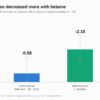
Body composition. The BMI in the betaine group decreased by an average of 2.18 points, compared to 0.58 points in the control group (p < 0.001). The waist-to-hip ratio also improved more significantly (p < 0.001), and the body fat percentage in the betaine group decreased by an average of 2.61 percentage points, while it rose slightly in the control group. This last difference is striking: it suggests that it was not just about “weight loss,” but about a more favorable shift in fat mass.
Blood sugar and fats. Fasting blood sugar decreased more significantly in the betaine group (from an average of 6.60 to 5.80 mmol/l, compared to 6.60 to 6.40 mmol/l in the control group; p < 0.001). Triglycerides and LDL cholesterol (“bad” cholesterol) also decreased significantly more in the betaine group.
Homocysteine. This was the primary focus of the study, and here the difference was clearest: the betaine group showed an average decrease in homocysteine of 40.4 percent, compared to 23.6 percent in the control group. In other words: on top of the effect of folic acid and B-vitamins, the addition of betaine resulted in a considerably larger decrease.
Atherogenic index of plasma (AIP). This measure, which indicates the risk of vascular narrowing, also improved more significantly in the betaine group. The researchers refer to previous work showing that every 0.1 point decrease in AIP is associated with approximately a 10 percent lower risk of cardiovascular events — although this is an indirect, epidemiological estimate and not a directly proven effect from this study itself.
Finally: no side effects were reported in either group that caused participants to stop. As far as this short-term study can assess, the betaine supplement was well tolerated.
Why might betaine have an advantage?
The researchers discuss several mechanisms that could explain why betaine shows an additional effect on top of folic acid and B-vitamins. It essentially comes down to betaine working via a different route than folic acid.
Folic acid and vitamin B12 depend on an enzyme called methylenetetrahydrofolate reductase (MTHFR) to pass their methyl group to homocysteine. In a portion of the population, this enzyme works less efficiently due to genetic variation, making folic acid supplementation alone less effective. Betaine bypasses this step: it delivers its methyl group directly via the enzyme betaine-homocysteine methyltransferase in the liver, independent of MTHFR or the availability of vitamin B12. This would explain why the combination with betaine goes further than folic acid and B-vitamins alone, even in people whose classic route is not functioning optimally.

Average decrease in homocysteine compared to baseline, after 8 weeks of supplementation (n = 90). Source: Zhang et al., Nutrición Hospitalaria 2026;43(3):553-560
Additionally, the article describes several broader metabolic effects of betaine that go beyond just homocysteine:
- Anti-inflammatory effects. Betaine may inhibit the activity of NF-κB and the NLRP3 inflammasome, two key players in low-grade inflammation, thereby contributing to reduced cellular stress.
- Insulin sensitivity. By reducing stress in the endoplasmic reticulum (a cell component involved in protein production), betaine could improve glucose tolerance and insulin sensitivity.
- Fat metabolism. Via the PPARα signaling pathway and by activating AMPK, betaine may stimulate the oxidation of fatty acids, while supporting muscle protein synthesis via the mTOR pathway — summarized as a shift toward “less fat, more muscle”.
- HDL cholesterol. Betaine may increase the production of the transport protein ABCA1, which in turn is linked to better production of HDL cholesterol (the “good” cholesterol).
- Adipose tissue and gut flora. Animal studies cited in the article suggest that betaine, via signals from the gut flora (specifically a microRNA called miR-378a), can stimulate the so-called “browning” of adipose tissue — a process where fat tissue more actively burns energy instead of simply storing it.
It is important to add a caveat here: some of these mechanisms have been demonstrated in cell and animal studies, not directly in the participants of this specific study. The researchers present them as plausible explanations for what they observed in the people in their study, not as proven mechanisms of action in the human subjects of this research itself.

Average BMI decrease compared to baseline, after 8 weeks of supplementation (n = 90). Source: Zhang et al., Nutrición Hospitalaria 2026;43(3):553-560
What does this mean for you?
If you are already familiar with TMG, for example because you use it alongside NMN or as part of a methylation-supporting routine, this study confirms something that has appeared frequently in broader literature: betaine is more than just “an extra methyl donor”. The combination with classic B-vitamins and folic acid appears to provide a stronger and more broadly supported improvement than B-vitamins alone, both for homocysteine itself and for related metabolic values such as blood sugar, lipid profile, and body composition.
That being said: this study concerned people with a confirmed, elevated homocysteine level (above 15 µmol/l) and overweight or obesity. It is not a study of what betaine does in people with normal levels, and it is certainly not a substitute for medical advice. If you have symptoms or suspect your homocysteine level is elevated, a blood test through your doctor is the correct first step — a dietary supplement is a complement to a healthy lifestyle, not a diagnostic or treatment tool.
The limitations: what should you keep in mind?
Honest conclusions should also include honest caveats, and the researchers are clear about this themselves:
- Small study, single center. With 90 participants completing the study, this is a relatively small study conducted in one hospital in China. Larger, multicenter studies are needed to see if the results hold true universally.
- Short duration. Eight weeks is enough to measure change, but too short to say anything about long-term effects, such as whether the improvements persist or if people relapse over time.
- Mechanism of action not yet fully elucidated. As described above, part of the explanation comes from animal and cell studies, not directly from this population.
- No gender distinction. The researchers did not look at whether men and women reacted differently to the intervention, whereas this can sometimes matter in metabolic research.
- Specific population. All participants were Chinese adults with overweight and a pre-established elevated homocysteine level. Whether the results would be the same in, for example, a Western population with a more varied diet, has not been separately investigated.
These are not reasons to ignore the results — it is a carefully designed, randomized study with clear measurements — but they are reasons to view the outcomes as a strong indication rather than the final word.
Summary
This study adds a concrete piece of evidence to what was already known about betaine (TMG): in people with overweight and elevated homocysteine levels, eight weeks of supplementation with a betaine-containing supplement, on top of folic acid and B-vitamins, resulted in a significantly stronger decrease in homocysteine than B-vitamins alone, along with more favorable effects on blood sugar, lipid profile, body composition, and the atherogenic index of plasma. The explanation seems to lie in the way betaine provides methyl groups via a separate route, independent of the route that relies on folic acid and vitamin B12, combined with broader effects on inflammation, insulin sensitivity, and fat metabolism.
As with any single study: it is one study, with a limited scope and duration, conducted in a specific population. It is interesting enough to take seriously, but not enough to base definitive statements on. Those interested in the role of methyl donors like betaine within a healthy, active lifestyle would do well to continue following this type of research — and in case of doubt about their own homocysteine levels, always consult a physician first.
Frequently asked questions about betaine (TMG) and homocysteine
What is the difference between betaine and TMG?
They are exactly the same substance. Betaine is also known as trimethylglycine, abbreviated as TMG — the name refers to the three methyl groups attached to the amino acid glycine. In scientific literature, such as the study discussed here, the term “betaine” is usually used; in the supplement industry, you more often see “TMG”. Read more here.
Can I combine betaine with folic acid and vitamin B12?
In this study, all participants received folic acid and B-vitamins; the betaine group received these in addition to the betaine supplement, not instead of it. The researchers therefore view betaine as a supplement to classic methyl nutrients, not a replacement.
Is a high homocysteine level always a problem?
A single elevated reading does not automatically indicate a health issue; homocysteine can fluctuate temporarily due to diet, dehydration, or other factors. A structurally elevated level (such as the threshold of 15 µmol/l used in this study) is, however, a reason to discuss appropriate next steps with a physician.
Did this study also look at side effects?
Yes. Participants were monitored over the eight-week period for complaints such as gastrointestinal issues or an unpleasant aftertaste. No participants were reported to have stopped for these reasons, indicating good short-term tolerability of the supplement used, though this does not yet confirm long-term safety.
Source: Zhang L, Zhang Y, Yang D, Yang C, Rong X, Li X, Zhang X, Zhang J, Zhang P. “Effects of betaine-containing nutrients on homocysteine levels and glucose-lipid metabolism in overweight and obese patients with hyperhomocysteinemia.” Nutrición Hospitalaria 2026;43(3):553-560. DOI: 10.20960/nh.05892
This article is intended for informational purposes only and does not replace medical advice. Always consult a physician if you have concerns about your health.