

NMN research 2026 is an important topic for anyone delving into longevity, healthy aging, NAD+, and supplements for cellular energy. In this article on NMN research 2026, we examine human studies, safety, dosage, and scientific evidence. More and more people are searching for terms such as nmn human clinical trials 2025 2026, nmn human studies, nmn scientific evidence, and nmn safety. The question is logical: what do we actually know by now from research in humans?
NMN stands for nicotinamide mononucleotide. It is a substance that the body uses as a precursor to NAD+, a coenzyme involved in cellular energy processes, metabolism, and repair mechanisms. Because NAD+ plays a central role in many cellular processes, interest in NMN has grown significantly in recent years.
At the same time, nuance is important. Many claims about NMN originate from animal studies, cell research, or marketing copy. Human studies are more valuable, but often still relatively small, short-term, and focused on biomarkers such as NAD+ metabolites, tolerability, or functional test results. In this article, we clearly outline the state of affairs in 2026.
Short answer: NMN research 2026 shows that NMN can increase NAD+-related biomarkers and is generally well-tolerated in short human studies. There is still insufficient evidence that NMN slows human aging or extends lifespan.
The goal of this blog on NMN research 2026 is to separate hype from science. We look not only at positive signals but also at limitations: small study groups, short study durations, biomarkers instead of hard health outcomes, and the lack of long-term data.
NMN research 2026 summarized
The short conclusion: NMN is scientifically interesting, and human studies show that oral NMN supplementation can increase NAD+-related biomarkers. Safety in short-term studies generally appears favorable. However, hard claims regarding anti-aging, lifespan extension, or disease prevention have not yet been proven.
- NMN is an NAD+ precursor: the body can use NMN within pathways involved in NAD+ metabolism.
- Human studies show biological activity: multiple studies show that NMN can influence NAD+-related biomarkers.
- Safety appears favorable in short studies: in studies lasting from several weeks to months, no major safety concerns have generally been observed.
- Effects on health are mixed: results regarding physical performance, metabolism, blood pressure, or well-being vary by study.
- Anti-aging claims remain premature: there is as yet no evidence that NMN demonstrably slows human aging.
- More research is needed: especially larger, longer, independent studies with clinically relevant outcomes.
What exactly is NMN?
NMN, short for nicotinamide mononucleotide, is a molecule involved in the production of NAD+. NAD+ stands for nicotinamide adenine dinucleotide. This coenzyme occurs in cells and plays a role in energy production, redox reactions, DNA repair processes, and the activity of enzyme families such as sirtuins and PARP enzymes.
Because NAD+ is involved in fundamental cellular processes, much research is being conducted into ways to support NAD+ levels. Various precursors are being investigated, such as nicotinamide riboside, niacin, nicotinamide, and NMN.
NMN is therefore not a simple “energy pill.” It is a building block within a complex biochemical network. The real research question is not only whether NMN can increase NAD+-related markers, but also whether that leads to clear, measurable, and clinically relevant benefits in humans.
Would you like to understand the basics first? Please also read our explanation of what NMN is and how NMN works in the body.
Why does NMN research 2026 revolve around NAD+?
Interest in NMN stems from the broader interest in NAD+. NAD+ is involved in processes related to energy production, metabolism, stress response, and repair. Animal studies have shown that NAD+ metabolism can change during aging and certain disease processes.
In humans, the picture is more nuanced. Researchers emphasize that NAD+ dynamics in human tissues have not yet been fully mapped. Blood levels or peripheral biomarkers do not always accurately reflect what is happening in specific tissues, such as muscle tissue, liver, brain, or immune cells.
That is why human studies are important. Only controlled research in humans can clarify what NMN actually does, for whom it may be relevant, what dosage is meaningful, and where the limits lie.
What do human NMN studies say so far?
Human NMN studies through 2026 primarily focus on four main questions:
- Does NMN increase NAD+-related biomarkers in humans?
- Is NMN safe and well-tolerated?
- Does NMN have measurable effects on physical performance, metabolism, or vascular markers?
- What dosage is meaningful and for whom?
The answer to the first question is the most positive: oral NMN supplementation appears to be able to increase NAD+-related biomarkers in several human studies. Short-term safety also appears favorable in many studies.
The third and fourth questions are more difficult. Effects on functioning, metabolism, blood pressure, and subjective well-being are variable. Some studies show interesting signals, but that does not yet mean that general health claims can be made.
What is new in NMN research 2026?
In 2026, it is particularly striking that NMN research is becoming broader than just “anti-aging.” A notable development is research into NMN within specific medical contexts, such as immunometabolism. For example, NMN was investigated in a phase 1/2 study in adults with steroid-refractory or steroid-dependent immune thrombocytopenia.
This is important, but also something to be cautious about. This type of research is not intended as proof that NMN makes healthy people younger or has general anti-aging effects. It primarily shows that the CD38-NAD+ axis and NMN can be biologically relevant in specific medical contexts.
Additionally, in 2026, there is more focus on systematic reviews of NAD+ supplementation. These reviews look more broadly at NAD+ precursors such as NMN, NR, and NAM. The common thread: NAD+ precursors can influence biomarkers, but the translation to broad healthspan or anti-aging effects in humans remains insufficiently proven.
Does NMN increase NAD+ in humans?
The most consistent finding in NMN research is that supplementation can increase NAD+-related biomarkers. This is important because it shows that NMN is biologically active. It supports the idea that NMN is not just theoretically interesting but can actually influence NAD+ metabolism.
However, a higher biomarker value is not automatically the same as a proven health benefit. Biomarkers are intermediate steps. They can be useful for understanding a mechanism, but ultimately researchers want to know if people functionally improve from it.
Examples of more clinically relevant outcomes include muscle function, endurance, metabolic health, inflammatory markers, quality of life, or disease outcomes. For these, the evidence is still less robust than for the effect on NAD+-related markers.
NMN and safety: what do we know?
Safety is an important topic for anyone considering NMN. Human studies so far have primarily looked at short-term use, often lasting several weeks to a few months. During these, blood values, liver and kidney parameters, side effects, and general tolerability were monitored.
In various short-term studies, NMN was generally well-tolerated. However, this does not mean that NMN is automatically suitable for everyone. Short studies say little about use over many years, specific risk groups, or combinations with medication.
Extra caution is advised during pregnancy, breastfeeding, active medical conditions, use of medication, or treatment for cancer, immune diseases, or chronic conditions. In these situations, always consult a physician or pharmacist.
Would you like to read specifically about potential complaints or points of attention? Then view our page on NMN side effects.
NMN research 2026 and physical performance
A number of human studies have looked at physical performance, for example through walking tests, endurance, or subjective questionnaires. Some results point to improvements in certain performance measures, but the evidence is not yet strong enough to make general claims.
Why not? Because studies differ in participants, dosage, duration, measurement methods, and design. An improvement in a test in a specific group does not automatically mean that every healthy user will experience more energy, better sports performance, or faster recovery.
For consumers, this means: do not see NMN as a replacement for training, sleep, recovery, and nutrition. If NMN does anything for performance or energy, it likely fits primarily within a broader routine.
NMN research 2026 and metabolism
NMN is also being investigated in relation to metabolism, insulin sensitivity, and energy balance. This is logical, as NAD+ is involved in metabolic processes.
Results in humans have been mixed so far. Some studies show interesting changes in biomarkers, while other studies find no clear improvement in clinically relevant outcomes.
The current state of affairs is therefore: NMN is biologically plausible and scientifically interesting, but it is not a proven treatment for metabolic conditions. Those with issues regarding blood sugar, weight, insulin resistance, or diabetes should not see NMN as an alternative to medical supervision, nutrition, exercise, or prescribed treatment.
NMN and blood pressure
There is also attention to potential effects of NMN on blood pressure and cardiovascular markers. Some analyses suggest that NMN may have small effects on certain blood pressure parameters, but the clinical significance of this is still uncertain.
A small change in a biomarker is not the same as proven protection against cardiovascular disease. For that, larger, longer-term studies are needed with hard endpoints such as disease incidence, hospitalizations, or cardiovascular events.
For cardiovascular health, lifestyle factors such as sufficient exercise, healthy nutrition, not smoking, sleep, stress management, and medical check-ups remain more important than supplements.
NMN and healthy aging
The greatest interest in NMN revolves around healthy aging. Here, it is important to distinguish between three levels of evidence:
- Biological plausibility: NMN fits into NAD+ metabolism, and NAD+ is important for cellular processes.
- Biomarker evidence: human studies show that NMN can influence NAD+-related markers.
- Clinical evidence: proof that NMN demonstrably allows people to age more healthily, prevents disease, or extends lifespan.
There is increasing support for levels 1 and 2. For level 3, the evidence is still insufficient. Therefore, it is better to say that NMN is being investigated within the context of healthy aging, rather than claiming that NMN slows aging.
NMN research 2026: what dosage is being investigated?
Dosages in human NMN studies vary. There are studies with lower dosages, but also studies with several hundred milligrams per day. Some studies use 300 mg, 600 mg, or 900 mg per day. Other research looks at temporary higher dosages or specific medical applications.
This does not mean that more is automatically better. A higher dosage can be more expensive, increase the chance of discomfort, and is not necessarily more effective. The optimal dosage likely depends on age, health, goal, body weight, sensitivity, baseline values, and personal response.
For consumers, it is wise to always follow the recommended dosage on the packaging and start slowly. Would you like more practical explanation? Read our page on NMN dosage.
NMN powder or capsules: does it matter for research?
In research, fixed dosages are often used so that researchers know exactly how much someone is consuming. In practice, you can use NMN as a powder or as a capsule.
NMN capsules are convenient if you want ease of use and a fixed dosage. You don’t have to measure anything and know exactly how much you are using per capsule.
NMN powder is suitable if you want more flexible dosing. You can adjust the amount yourself and add the powder to your morning routine.
Which form is better depends mainly on your routine. For most people, consistent use is more important than the form itself.
NMN versus NR: what does research say?
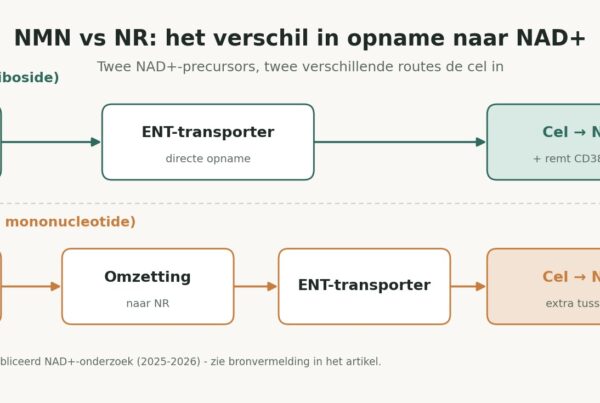
NMN and nicotinamide riboside, often abbreviated as NR, are both NAD+ precursors. There is much debate about which is better. At this moment, that cannot be definitively stated.
NR has relatively more human data, while NMN is rapidly gaining ground in clinical research. Both can influence NAD+-related biomarkers. Differences in absorption, tissue-specific effects, and clinical outcomes are still subjects of research.
For consumers, the most important question is not only which NAD+ precursor is theoretically better, but also which product is reliable, well-dosed, practical to use, and fits their own routine.
What do we not yet know?
Despite the growth of NMN research, many open questions remain. The main uncertainties are:
- What is the optimal dosage for different age groups?
- What are the effects of use over many years?
- Which people respond strongly, moderately, or hardly at all?
- Which biomarkers predict real health benefits?
- What happens in specific tissues such as muscles, liver, or brain?
- How does NMN compare to other NAD+ precursors such as NR?
- Are there situations in which NMN should be discouraged?
An important conclusion from NMN research 2026 is therefore not only what we do know, but also what remains uncertain. It is precisely this uncertainty that makes it important to be cautious with major claims about anti-aging, lifespan, or disease prevention.
How should you evaluate NMN claims?
A good rule of thumb: the larger the claim, the stronger the evidence must be. Claims such as “supports NAD+ metabolism” or “is being investigated within healthy aging” are more cautious and realistic than claims such as “rejuvenates your body” or “stops aging.”
When reviewing NMN content, look for the following signals:
- Is a distinction made between animal studies and human studies?
- Are results from biomarkers not exaggerated?
- Are uncertainties mentioned?
- Are medical claims avoided?
- Are sources cited?
A reliable approach is nuanced: NMN is interesting, but not a magic solution.
NMN research 2026: practical conclusion for users
Based on the state of affairs in 2026, you can view NMN as an interesting supplement within the broader category of NAD+ precursors. Human studies primarily support that NMN has biological activity and can influence NAD+-related biomarkers. Short-term safety appears favorable in many studies, but long-term data remains limited.
Those who wish to use NMN should preferably choose a product with clear dosage, transparent information, and a form that fits their daily routine. Capsules are practical for convenience and fixed dosage. Powder is suitable for those who want more flexible dosing.
Would you like to read more about purchase criteria first? Then view our page on the best NMN supplement. Would you like to order directly? Then go to Buy NMN at Every Day Better.
Sources and further reading
Recent external sources on NMN, NAD+ supplementation, and human studies were used for this article. Would you like to read more deeply? Then view, among others:
- PRISMA review on NAD+ supplementation, anti-aging, and wellness
- Nature Medicine phase 1/2 study with NMN in immune thrombocytopenia
- Nature Metabolism review on NAD+ precursors in human aging research
- Randomized NMN study with 300, 600, and 900 mg per day in healthy adults
- Study on NR, NMN, and nicotinamide as NAD+ boosters in healthy adults
Frequently asked questions about NMN research 2026
What is the main conclusion from NMN research in 2026?
The main conclusion is that NMN is biologically active and can increase NAD+-related biomarkers. At the same time, hard claims about anti-aging, lifespan, or disease prevention remain insufficiently proven.
Why is NMN research 2026 important?
NMN research 2026 is important because more and more human studies and reviews are appearing regarding NAD+, NMN, safety, and potential health effects. At the same time, the research shows that many claims have not yet been definitively proven.
Are there human studies with NMN?
Yes, there are human studies with NMN. These studies examine, among other things, safety, NAD+-related biomarkers, physical performance, metabolic markers, and specific medical applications.
Is NMN safe according to research?
In short-term human studies, NMN generally appears to be well-tolerated. However, there is still limited evidence regarding use over many years and specific risk groups. If in doubt, consult a physician or pharmacist.
Does research prove that NMN slows aging?
No. NMN is being investigated within the context of healthy aging, but there is as yet no evidence that NMN demonstrably slows human aging or extends lifespan.
What dosage is used in NMN studies?
Dosages vary by study. In human studies, dosages of several hundred milligrams per day are used, among others. Always follow the recommended dosage on the packaging.
Which is better: NMN powder or capsules?
That depends on your preference. Capsules are convenient for ease of use and fixed dosage. Powder is suitable if you want flexible dosing.
Can I combine NMN with TMG?
Many people combine NMN with TMG within a broader longevity routine. TMG is often mentioned because of its role in methylation processes. Consult a professional for medical questions.
Conclusion
The NMN research 2026 is promising but requires nuance. An important conclusion from NMN research 2026 is that NMN is an interesting NAD+ precursor with measurable biological activity in human studies. Short-term safety appears favorable in many studies, but effects on actual health outcomes have not yet been definitively proven.
The best conclusion is therefore: NMN is not a miracle cure, but it is a seriously researched supplement within the world of NAD+, cellular energy, and healthy aging. Those who use NMN do so best as part of a broader lifestyle including sleep, nutrition, exercise, recovery, and realistic expectations.