NMN in 2025 Nicotinamide Mononucleotide (NMN) remains a hot topic in the world of health and anti-aging. Because of the promise of extended lifespan, improved cellular function and the ability to slow aging, it is not surprising that many people are curious about the effectiveness of this supplement. The question many are asking is: Is NMN really the breakthrough it promises to be, or is it just temporary hype? In this blog, we delve into the scientific developments surrounding NMN, look at recent clinical studies, and explore what the science on NMN will have to say about this popular molecule in 2025.
What is NMN?
Nicotinamide Mononucleotide, often abbreviated as NMN, is a molecule that occurs naturally in our bodies. It plays an essential role in the production of Nicotinamide Adenine Dinucleotide (NAD⁺), a substance critical to many vital processes, such as cellular energy, DNA repair and regulating the aging process. As we age, levels of NAD⁺ decrease, which can negatively impact the health and longevity of our cells. This is exactly where NMN comes in – as a way to compensate for the decrease in NAD⁺, thus slowing aging and improving health.
- NMN and NAD⁺: The supplement NMN is converted into NAD⁺ in the body, which is essential for energy production and cellular repair. This process has attracted significant interest in recent years, particularly with the rising interest in anti-aging supplements (Yoshino, J., et al., 2011).
Recent scientific research: NMN in 2025
Scientific research on NMN in 2025 has made significant progress in recent years. From preclinical animal studies to human clinical trials, the results show promising health benefits. In this section, we will examine some of the most relevant and recent scientific findings. In particular, studies conducted in 2025 provide a clearer picture of the effectiveness of NMN as a potential therapy against aging.
1. Preclinical Studies.
Many of the earliest studies on NMN were conducted in animals, such as mice and rats. These preclinical studies have provided important insights into how NMN can promote health and even extend lifespan. In this research, NMN is often linked to improved mitochondrial function, increased energy production, and the promotion of healthy aging. Initial results appear promising, although it is important to emphasize that these studies were conducted in animals and are not yet fully applicable to humans.
- Mitochondrial Health: A study conducted by Imai, S. et al. in 2023 demonstrated that NMN can improve mitochondrial function in mice, suggesting that the supplement may reduce the negative effects of aging on cells. These findings were published in Cell Metabolism (Imai, S. et al., 2023).
- Longevity Extension: In a study conducted by Mills, K.F. et al. in 2021, it was established that NMN extended the lifespan of mice by promoting higher NAD⁺ levels, which benefits cellular repair and overall health (Mills, K.F. et al., 2021).
2. Clinical studies in humans.
In addition to animal studies, an increasing number of human clinical studies have been conducted in recent years to test the efficacy and safety of NMN. These studies are particularly important because they help us understand whether NMN in 2025 actually provides the benefits it shows in animal models. New studies continue to be conducted in 2025 that suggest NMN may affect metabolic health, muscle strength, and aging effects in humans.
- Effect on Insulin Sensitivity: A randomized controlled study published in Endocrine Journal (2023) by Kanehisa, T. et al. investigated the effects of NMN on insulin sensitivity in healthy adults. The results show that NMN can have a positive influence on metabolic health, which is important for managing conditions such as type 2 diabetes (Kanehisa, T. et al., 2023).
- Increased Muscle Strength and Endurance: Another notable study conducted by Kawai, Y. et al. in The Journal of Clinical Investigation (2023) shows that NMN increases endurance and muscle strength in older adults. This could mean that NMN can contribute to the maintenance of physical capacities during the aging process (Kawai, Y. et al., 2023).
- Safety and Tolerability: Many NMN users are concerned about the safety of long-term use. Fortunately, research by Bokov, A. et al. (2022) in The Journal of Gerontology shows that NMN can be safely used at dosages up to 1,000 mg per day without significant side effects or negative health impacts (Bokov, A. et al., 2022).
Key mechanisms of action
What actually makes NMN so effective? It’s all about NAD⁺. NMN increases NAD⁺ levels in the body, which is an important factor in regulating cellular functions, such as DNA repair and energy production. These processes play a crucial role in aging and overall body health. Here we look at the main mechanisms that NMN influences.
- DNA Repair and Aging: NMN increases NAD⁺ levels, which plays a crucial role in repairing DNA damage and maintaining cellular health. Studies, such as those by Zhang, H. et al. in 2020, show that increasing NAD⁺ via NMN can slow down cellular aging by promoting the repair of DNA damage and supporting the overall health of organs such as the liver and heart (Zhang, H. et al., 2020).
- Cognitive Health: In addition to physical health, NMN also appears to influence the brain. Research by Mochizuki, M. et al. shows that NMN can help maintain cognitive functions in the elderly by improving neuronal health and activating key proteins such as SIRT1, which are involved in aging and memory (Mochizuki, M. et al., 2021).
Risks and side effects
Although NMN is generally considered safe, it is important to be aware of the possible risks and side effects. As with other supplements, NMN may cause mild side effects in some people. It is crucial to look at the long-term safety of using NMN to ensure that it does not have adverse effects when taken over long periods of time.
- Long-term effects: Many of the studies on NMN are short term, so we cannot yet fully understand the long-term effects of using NMN. Large-scale and long-term studies are needed to get a better picture of long-term safety.
- Side Effects: Although most studies report few to no side effects from NMN, there are reports of mild digestive issues at higher dosages (more than 1,000 mg per day). It is always advisable to start with lower doses and monitor your body’s response (Bokov, A. et al., 2022).
Market trends and regulation
The popularity of NMN has grown exponentially in recent years. This has led to a booming market for NMN supplements, but also to concerns about the quality of available products. In this section, we look at current trends in the NMN market and how regulation is evolving.
- Regulation: In the United States, the FDA has approved NMN as a supplement, but it is not yet considered an approved drug. However, there is growing interest in approving NMN as a therapy, given its promising health benefits. Regulation of NMN is likely to become more stringent in the coming years as more scientific data becomes available.
- Certifications: Consumers are becoming more discerning about the quality of the supplements they buy. Choosing NMN products with reliable certifications, such as USP or NSF, can help ensure the safety and effectiveness of the product.
Future directions and conclusion
The science surrounding NMN in 2025 is promising, but we are still in the early stages of research. While preclinical animal studies show impressive results, we must be patient until more clinical data becomes available to confirm efficacy in humans. In the future, we expect to see a greater understanding of the long-term effects of NMN and that it may play an important role in aging therapies.
- Large-scale Clinical Trials: There is a growing need for large-scale, long-term clinical trials that can evaluate the long-term effects of NMN.
- New Innovations in Administration: Innovations in delivery methods, such as sublingual or intranasal NMN supplements, could improve the effectiveness of NMN by accelerating absorption and increasing bioavailability.
In conclusion, although NMN shows promise as an anti-aging solution and health supplement in 2025, more research is needed to determine how effective it really is and whether it is safe in the long term. Until then, it is important to stay well-informed and use NMN with care.
Sources NMN in 2025 :
- Yoshino, J., et al. (2011). “Nicotinamide mononucleotide and nicotinamide riboside: pathways to NAD+.” PubMed. Link
- Imai, S., et al. (2023). “Nicotinamide mononucleotide and mitochondrial function.” Cell Metabolism. Link
- Mills, K.F. et al. (2021). “Nicotinamide Mononucleotide extends lifespan and improves health.” Nature Communications. Link
- Kanehisa, T. et al. (2023). “Effect of NMN on insulin sensitivity in healthy adults.” Endocrine Journal. Link
- Kawai, Y. et al. (2023). “Effect of NMN on muscle strength and endurance in older adults.” The Journal of Clinical Investigation. Link
- Bokov, A. et al. (2022). “Safety and tolerability of NMN in long-term supplementation.” The Journal of Gerontology. Link
- Zhang, H. et al. (2020). “Nicotinamide Mononucleotide and DNA Repair in Aging.” PubMed. Link
- Mochizuki, M. et al. (2021). “Cognitive effects of NMN supplementation in elderly individuals.” Neurobiology of Aging. Link

NMN supplements for energy and vitality
NMN supplements: what is nicotinamide mononucleotide and what should you look for?
NMN, short for nicotinamide mononucleotide, is a precursor to NAD⁺ — a naturally occurring substance in the body that plays an important role in energy production, cellular repair, and processes associated with healthy aging. More and more people are choosing to incorporate NMN supplements into their daily routine, focusing on energy, vitality, and mental clarity.
On this page, you’ll discover what NMN is, how it works in relation to NAD⁺, the difference between NMN capsules and NMN powder, and what to look for when buying NMN.
What is NMN (nicotinamide mononucleotide)?
Nicotinamide mononucleotide (NMN) is a molecule naturally produced in the body that is converted into NAD⁺ (nicotinamide adenine dinucleotide). NAD⁺ is involved in hundreds of biochemical processes, including energy production in the mitochondria, DNA repair and cellular recovery, and the activation of enzymes that contribute to cellular health.
As we age, NAD⁺ levels gradually decline. This is one of the reasons NMN is often used within a longevity-focused lifestyle, with a focus on energy, recovery, and vitality at the cellular level.
How does NMN work in the body?
After intake, NMN is converted by the body into NAD⁺. This molecule plays a key role in processes that directly influence how you feel and function, such as your energy metabolism and cellular maintenance.
Because NAD⁺ levels decline with age, many people choose to use NMN to support these natural processes. As a result, NMN is popular among individuals who are consciously focused on their health, performance, and long-term vitality.
Want to dive deeper? Also check out how NMN works and the science behind NMN.
What are the benefits of NMN?
NMN is often used as part of a daily routine aimed at supporting cellular energy production, mental clarity and focus, recovery after physical exertion, and healthy aging at the cellular level.
- Support for cellular energy production
- Mental clarity and focus
- Recovery after physical exertion
- Healthy aging at the cellular level
The effects experienced may vary per individual and depend on factors such as lifestyle, nutrition, and consistent use.
Want to read more? Check out everything about NMN and 12 things you should know about NMN.
NMN capsules or NMN powder: which is right for you?
Within this category, you can choose between NMN capsules and NMN powder. Both forms contain the same active ingredient but differ in usage and flexibility.
NMN capsules
- Easy to use
- Fixed dosage
- Ideal for daily convenience and consistency
NMN powder
- Flexible dosing
- Suitable for personal optimization
- Often chosen by experienced users
Not sure which to choose? Go for capsules if convenience and routine matter most, and powder if you want more control over your dosage.
Explore our NMN capsules or visit the shop for the full range.
Who is NMN suitable for?
NMN is often used by people who want to support their energy and vitality, are consciously working on healthy aging, want to build a longevity routine, or are looking for more structure and consistency in their supplement use.
- People who want to support their energy and vitality
- People focused on healthy aging
- People building a longevity routine
- People seeking structure and consistency in supplement use
Also read Start every day better with NMN for more context on how NMN fits into a broader routine.
How do you use NMN?
NMN is typically used daily as part of a consistent routine. The exact dosage may vary depending on the individual and their goals. Consistency plays an important role. Many users choose to take NMN in the morning as part of their daily start.
Want to learn more? Read more about NMN dosage.
NMN vs NR: what’s the difference?
In addition to NMN, there is another NAD⁺ precursor: NR (nicotinamide riboside).
- NMN is converted more directly into NAD⁺
- NR is first converted into NMN before becoming NAD⁺
Both compounds are used with the same goal: supporting NAD⁺ levels in the body.
Read the full comparison on NMN vs NR.
What should you look for when buying NMN?
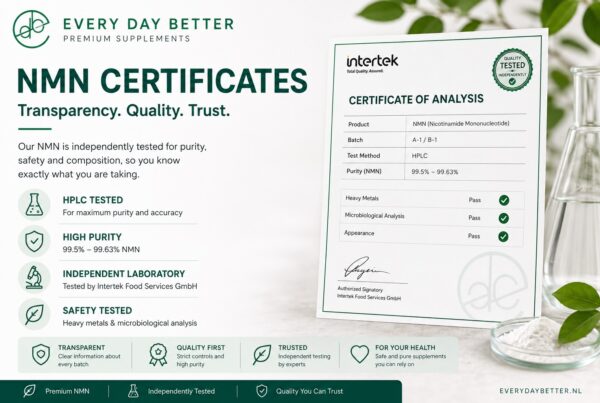
The quality of NMN supplements can vary significantly. Pay attention to the purity of the raw material, independent testing and transparency, a clear dosage per serving, the absence of unnecessary additives, and reliable sourcing and production.
- Purity of the raw material
- Independent testing and transparency
- Clear dosage per serving
- No unnecessary additives
- Reliable sourcing and production
Want to see how Every Day Better approaches this? Check out our NMN certificates and read why buy NMN from Every Day Better.
Why choose Every Day Better?
At Every Day Better, quality and transparency are central. Our NMN supplements are independently tested, contain no unnecessary additives, are developed for daily use, and align with a conscious, long-term health routine.
When you choose NMN from Every Day Better, you choose a thoughtful approach that fits within a sustainable and consistent lifestyle.
Learn more about our vision on Expert in longevity supplements.
Frequently asked questions about NMN
What exactly is NMN?
NMN is a naturally occurring substance that is converted into NAD⁺, an important molecule for energy and cellular health.
What is the difference between NMN and NAD⁺?
NMN is a precursor to NAD⁺. The body converts NMN into NAD⁺.
Are NMN capsules better than powder?
That depends on your preference. Capsules are easier to use, while powder offers more flexibility in dosing.
What should you look for when buying NMN?
Pay attention to purity, independent testing, and brand transparency.
Does NMN fit into a daily routine?
Yes, many people use NMN daily as part of a longevity-focused lifestyle.
Find more answers on our page with frequently asked questions about NMN and on the page about NMN side effects.
Discover your NMN routine
Whether you start with NMN capsules or choose NMN powder, in this category you’ll find supplements that match your goals.
Explore the products and discover what best fits your daily routine for energy, vitality, and cellular health. You can go directly to our NMN capsules or browse the full range in the Every Day Better shop.